How Vellichor Literary Replaced Google Forms and Built a Scalable Submissions System with Dapple
Vellichor Literary is an indie literary magazine with over 100,000 Instagram followers. They were managing monthly poetry calls, themed issues, and editorial recruitment entirely through email and Google Forms. As submissions surged into the hundreds, the system broke. Dapple gave them one place for every call, every submission, and every decision.
Background
What is Vellichor Literary, and what do they publish?
Vellichor Literary is an independently run multimedia magazine based in San Francisco, founded by Ben Ramakrishnan. Their tagline — “for the dissonant, the tender, and the unbecoming” — reflects the kind of work they publish: writing and art that resists easy categorisation. With seven print issues, a monthly poetry and prose contest called Ariadne's Thread, themed open calls, and a Discord community of over a thousand members, Vellichor has built one of the most ambitious indie literary operations running today.
Their output spans print magazines, digital anthologies, a Substack newsletter, short film production, and a steady pipeline of calls for poetry, prose, and visual art. Before Dapple, all of this was being managed manually.
The Problem
Why did Google Forms stop working for Vellichor's submission process?
Google Forms is quick to set up, but it isn't built for high-volume literary operations. As Vellichor scaled, the cracks appeared: monthly calls, themed issues, and Ariadne's Thread were running simultaneously with different guidelines and deadlines, all feeding different inboxes.
There was no unified view of submission status. Editors were downloading attachments manually, recording decisions in separate sheets, and handling follow-up one message at a time. For writers, there was little visibility after submission — often silence until a final decision.
"We were growing faster than our systems could handle. Managing calls manually was chaotic. We needed a better way to organise everything."
— Ben Ramakrishnan, Founder, Vellichor Literary
Getting Started
How did Vellichor move from Google Forms to Dapple?
The first major change was consolidation: one branded listings page where every open call appears in one place. Writers bookmark one URL. Editors manage one dashboard. The fragmentation of separate links and separate form stacks disappears.
For recurring programmes like Ariadne's Thread, Vellichor now duplicates previous calls in seconds instead of rebuilding from scratch. That shifted setup from repetitive admin to a repeatable workflow with history intact.
The Solution
How does Vellichor manage multiple simultaneous calls in Dapple?
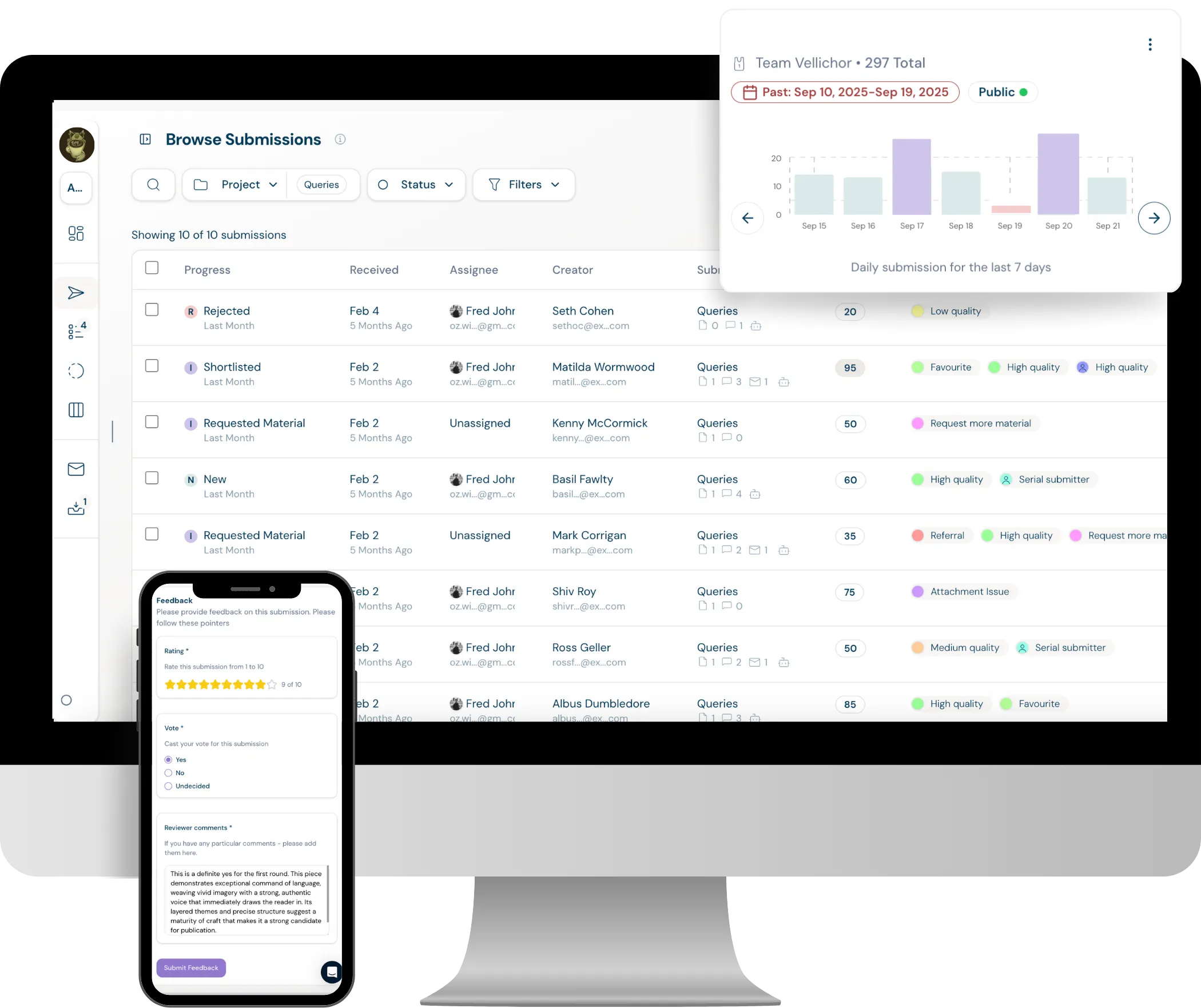
In Dapple, Vellichor's monthly contests, themed issues, blog calls, and recruitment projects all run as structured projects in one workspace. Calls are visible side by side, performance is comparable month to month, and editors can manage volume without losing editorial clarity.
All open calls visible in one dashboard — monthly contest, themed issues, and blog calls managed in parallel
Duplicate recurring calls (like Ariadne's Thread) in seconds, preserving settings and form logic
Track submission volumes and performance month-to-month across projects
One public listings page gives writers a single URL for every active call
No fragmented stack of separate forms and inboxes
Historical submissions remain searchable and structured over time
Stages & Messaging
How did Dapple's Stages feature transform Ariadne's Thread?
Ariadne's Thread is Vellichor's monthly poetry and prose competition. Before Dapple, entries were tracked manually, outcomes were communicated one by one, and each cycle required a fresh coordination effort.
With stages and in-platform messaging, each monthly cycle now follows a structured, repeatable workflow. Winning entries are moved into dedicated stages, and updates are sent in batches rather than via fragmented individual email threads.
"Duplicating our monthly poetry call now takes seconds. Everything's stored, tracked, and ready to go."
— Cara Goldstone, Editor, Vellichor Literary
Reviewing
How do Vellichor editors review and decide on submissions in Dapple?
Literary reviewing requires direct access to the work itself, not just metadata. In a forms-and-email workflow, editors jump between attachments, local folders, and spreadsheets to make decisions.
Dapple collapses that process into one interface: manuscripts are readable inside the platform, decisions are recorded in context, and contributor history is visible during review. That makes decision-making faster and more consistent without sacrificing editorial nuance.
Read attachments directly inside each submission — no local downloads
Leave notes and record decisions in context, without switching tools
Review metadata and manuscript together in one screen
See full creator profiles alongside submissions
Track returning contributors over time across multiple calls
Messaging
What does the submission experience feel like for writers?
Most submission tools optimise for internal admin and leave writers with little transparency. Vellichor uses Dapple to improve both sides: editors stay organised while submitters get clear, visible progress from submission to decision.
Writers can see submission history, live statuses, and updates in one place. For first-time submitters in particular, this clarity creates trust and reduces drop-off from uncertainty.
Writers see all past and current submissions in one place
Real-time status updates reduce uncertainty after submission
Direct messaging keeps submitter communication inside the platform
Clear feedback loops improve confidence for first-time submitters
"This is my first time submitting any of my writings anywhere and I just wanted to say that the whole process was so smooth. It was really impressive, truly."
— Vellichor Literary submitter
Post-Call Admin
How did Vellichor hire an editorial team using Dapple?
As submission volumes grew, Vellichor needed to rapidly expand editorial capacity. Instead of running recruitment through email, they launched hiring as a structured project inside Dapple.
The result was immediate: 250+ applications in one week, with reviews and offers managed in-platform. Using one system for both submissions and team-building meant no additional tools, and no extra process overhead.
Run editorial recruitment using the same workflow as submission calls
250+ applications received in one week via a structured Dapple project
Applications reviewed and shortlisted directly in-platform
Offers sent through Dapple without separate hiring tools
New editorial capacity built in days, not weeks
Post-Show Analytics
What operational visibility did Vellichor gain after switching?
Moving off Google Forms didn't just improve execution — it improved visibility. Vellichor gained a clear view of every active call, progression through each workflow stage, and submission behaviour over time across multiple projects.
That shared visibility reduced coordination friction and gave the team better signal for planning future calls, shaping editorial capacity, and identifying repeat contributors worth nurturing.
"Dapple has completely changed how we work. It's made managing submissions feel creative again — not chaotic."
— Ben Ramakrishnan, Founder, Vellichor Literary
Results
What changed for Vellichor after moving from Google Forms to Dapple?
The shift wasn't incremental. Admin that previously required manual coordination across disconnected tools now happens in one workflow. Time recovered from attachment chasing and repetitive setup now goes back into editing, curation, and publishing.
| Area | Before (Google Forms + Email) | After (Dapple) |
|---|---|---|
| Submission tracking | Manual spreadsheets, separate inboxes per call | All submissions in one dashboard, every call visible side by side |
| Recurring calls | Rebuilt from scratch each month | Duplicated in seconds with settings preserved |
| Reviewing work | Download attachments and switch to spreadsheets | Read attachments, leave notes, decide in one screen |
| Writer updates | Individual emails composed manually | Bulk messaging and status visibility inside Dapple |
| Submitter experience | No visibility after submitting | Live status tracking and direct messages |
| Team recruitment | Managed through email with no structured workflow | 250+ applications in one week; offers sent through Dapple |
| Writer discovery | No visibility into returning submitters | Full creator profiles with returning contributor history |
For a growing indie magazine, this is the core shift: one infrastructure for recurring open calls, submitter communication, editorial review, and team-building — without the operational drag of disconnected tools.
Why It Works
Why does Dapple work for indie literary magazines running multiple calls?
Vellichor's challenge is common: Google Forms works at low volume, but breaks once a publication runs multiple simultaneous calls and needs shared editorial visibility. Dapple is built for that exact pattern: recurring projects, collaborative review, and transparent communication with submitters.
The same platform now supports literary submissions, contests, contributor communications, and editorial recruitment. One tool, one URL for writers, one operating system for the team — giving Vellichor room to grow without process gridlock.
"Dapple has completely changed how we work. It's made managing submissions feel creative again — not chaotic."
— Ben Ramakrishnan, Founder, Vellichor Literary