Two in Five Entries Arrive in the Final 48 Hours. Here's the Data.
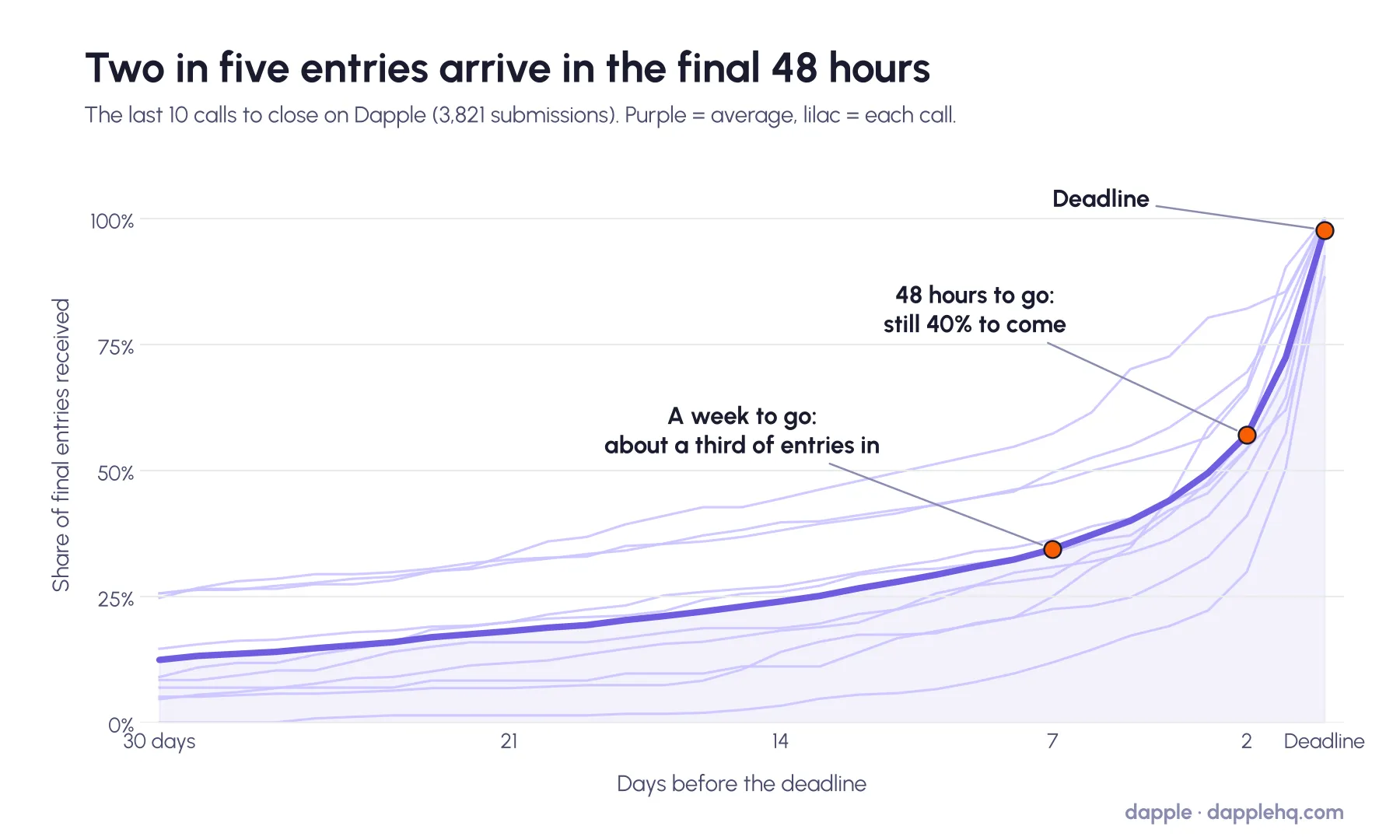
We analysed the last 10 calls to close on Dapple, a total of 3,821 submissions, to see what trends we could pull. A week before the deadline, only a third of entries were in. Here's what that means for organisers, and what to do when your numbers look low.
Published on October 20th 2026
Reading time: 6 mins
 Oz Osbaldeston, Co-founder & CEO, Dapple
Introduction
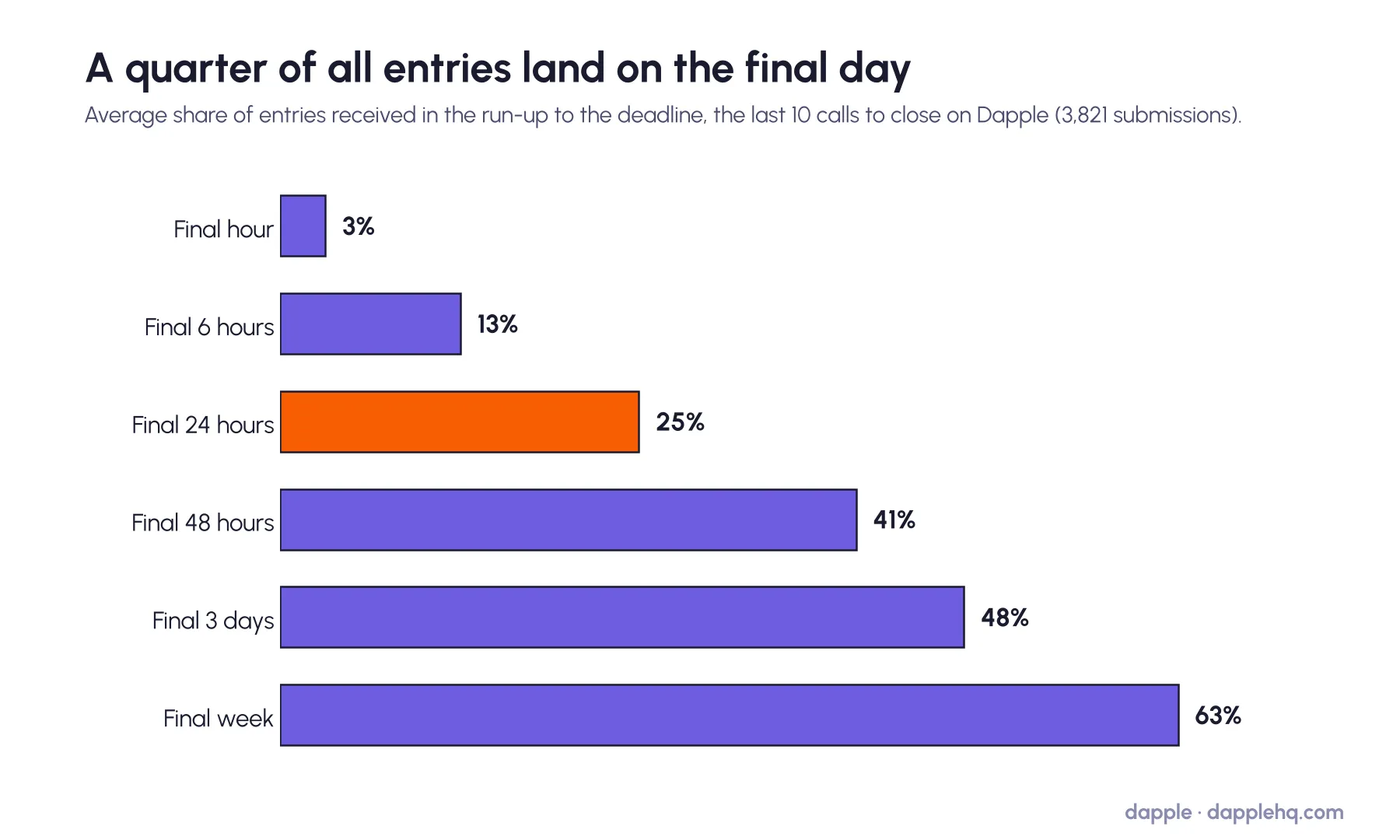
We put off tax returns, birthday presents and dentist appointments. Applications are no different. Across 3,821 submissions in the last 10 calls to close on Dapple, only about a third of entries had arrived a week before the deadline. Two in five came in during the final 48 hours, and a quarter on the final day. If your entries look a little thin three weeks in, it's actually very normal.
This matters because the quiet middle of an open call is where organisers panic. They extend deadlines, pay for extra ads or assume the call has failed, usually before most applicants have even pressed submit. Below is what submission volume actually looks like in the run-up to a deadline, why it happens, and what to do about it.
When Do Applicants Actually Submit Before a Deadline?
Most applicants submit in the final few days. On a typical open call on Dapple, only about 15% of entries arrive in the first half of the time the call is open. A week before the deadline, about a third of entries are in. Two days before, there's still 40% to come. Then the curve goes almost vertical.
In the chart at the top of this post, each faint line is one call. The pattern held across grants, artist residencies, juried exhibitions, writing prizes and competitions, design calls and visual arts open calls, from Miami to Seoul. It held whether the call was open for four weeks or more than three months. A longer window didn't really spread entries out, it just made the quiet stretch longer. The final hours are busier than most organisers expect. One residency on Dapple received 64 applications in the last two hours before its deadline.
Why Do People Leave Applications to the Last Minute?
People leave applications to the last minute because a deadline far away feels less urgent than everything else on their plate. Psychologists call this temporal discounting and it's not a new phenomenon. A 2006 study of student assignments found submissions accelerate at an increasing rate as the deadline gets closer, the same shape as our chart.
It isn't only procrastination, though. We all know that applications are hard work, sometimes requiring multiple hoops to jump through. Applicants polish portfolios, rewrite statements and chase references right up to the wire. On calls where applicants work in drafts, the typical entry was started between one and six days before it was actually submitted. A quiet dashboard doesn't mean nobody's applying. It means they're still working.
The behaviour is so consistent that an astronomer at the European Southern Observatory used five years of telescope proposal data to describe it with a single "deadline flurry" formula. It's human nature, not a sign your call isn't landing.
Is the Last-Minute Rush the Same for Grants and Awards Elsewhere?
Yes. Every funder and awards body that has published its numbers tells the same story, and some see an even sharper spike than we do.
| Who | What they found |
|---|---|
| NIHUS health research funder | 43% of applications to one round arrived on the due date itself |
| Visegrad FundCentral European grants | More than 50 of 251 applications came in during the final hour |
| SmartyGrantsAustralian grants platform | Nearly 1 in 10 grantseekers lodge in the last hour before the deadline |
| Imperial College London | A quarter of 213 grant proposals were submitted the day before or on the day |
| Foundant communitya funder with 13 years' experience | Roughly 10% arrive early, 20% one to two days out and 70% on deadline day |
Do Deadline Extensions Get You More Entries?
A deadline extension adds a few late entries, but it mostly moves the rush rather than spreading it out. On calls run on Dapple, entries received after the original deadline made up about 2% of the total, though this is an unfair statistic as some organisers extended the whole call, others extended it only for a handful of applicants who had already started, and some kept to a hard stop.
One juried exhibition took 144 entries on its original deadline day. The day after, with the extension announced, it got 15. Then 48 more arrived on the new final day, a second, smaller spike. A design open call did the same: 152 entries on deadline day, then 26 across a 24-hour extension.
So extend if there's a real reason: a technical problem, a holiday clash, a big group of applicants asking for it. Don't extend because the numbers looked low a week out. They were always going to look low a week out.
What Should You Do If Your Entries Look Low Before the Deadline?
Don't panic, and don't judge the call until the final 48 hours. Use the curve to forecast instead. A simple rule of thumb from our data: multiply the entries you have a week out by three, or add about 70% to what you have two days out. That's roughly where you'll land.
Then put your effort where it moves the number:
- Save your promotion for the final week. One reminder in the last seven days and another 48 hours out reaches people when they're actually ready to act. A post in week two mostly reaches people who'll forget.
- Nudge the people who've started. Applicants with a draft in progress are your most likely entries. A friendly "you're nearly there" email converts far better than a cold ad. You should be able to see in your submission platform how many people have started but not finished their submission. How can you convert those dilly-dallyers?
- Make the deadline impossible to misread. Give a date, a time and a time zone. Most of your entries will arrive in the last day, so ambiguity costs you.
- Get ready for the spike. Make sure your platform, payment flow and inbox can handle a third of your entries in 24 hours, and that someone's around to answer questions on deadline day.
Frequently Asked Questions
What percentage of applications are submitted on the last day?
About 25% of entries to open calls on Dapple arrive in the final 24 hours, and around 40% in the final 48 hours. Some funders report even more. NIH has seen 43% on the due date.
How long should an open call stay open?
Long enough for applicants to hear about it and prepare, usually four to eight weeks. A longer window won't spread entries out. Most will still arrive in the final week.
Should I extend my deadline if entries are low?
Only for a real reason, like a technical problem. An extension usually adds a few percent and creates a second last-minute spike.
How can I get more applications for my open call?
Most of it comes down to marketing: where you're promoting the opportunity, and whether that's where your applicants actually spend their time. Go beyond your own newsletter and social channels. Share the call in the Reddit communities, forums and message boards your applicants use, and list it on open call sites and opportunity databases for your field. Then time it well: focus your reminders on the final week, follow up with applicants who've started a draft, and make the deadline date, time and time zone crystal clear.
About the Data
This analysis covers 3,821 submissions to the last 10 calls to close on Dapple. They span grants, artist residencies, juried exhibitions, writing prizes and competitions, a design open call and visual arts open calls, run by organisations in the UK, US, Asia and beyond. We measured when each submission arrived relative to the call's deadline and averaged the results so each call counts equally.
Sources
- NIH Extramural Nexus: A grant submission New Year's resolution
- Visegrad Fund: 251 submitted project applications
- SmartyGrants: SmartyStats on how applicants lodge forms
- Imperial College London: Grant application process
- Foundant community: Grant application timeframe
- Dezeen: Dezeen Awards 2019 deadline extended
- Stoehr, F. (2017), The Deadline Flurry Formula, ESO
- Howell et al. (2006), Academic procrastination
Run Your Next Open Call on Dapple
Dapple is submission management software for grants, awards, residencies and open calls. It handles the deadline-day spike so you can focus on the applicants. Find out more about Dapple or book a demo.
Explore More
Why Your Submission Form Is the Reason You're Getting Fewer Applications
How a better form turns interested applicants into finished submissions.
How to Run an Open Call for Artists
A step-by-step guide to planning, promoting and running your open call.
Should Creative Organisations Charge Fees Upfront or at the End?
The pros, cons, and psychological impact of each fee-collection model.