The Best Award Management Software in 2026: 11 Platforms Compared
We compared 11 award management platforms on price, commission on entry fees, judging and setup time, including where each one falls short.

Published on October 23, 2026
Reading time: 16 minutes
 Oz Osbaldeston, Co-founder & CEO at Dapple
Prices and features checked against each vendor’s own website in October 2026.
What is the best award management software in 2026?
There is no single best award management platform. The right one depends on how many entries you take, whether you charge entry fees, and how complex your judging is. Award Force is the safest enterprise choice. Dapple is the best all-rounder: flexible, affordable, and able to run several awards, open calls and grants at once, from entry to post-award. Zealous suits organisations that want to start on a free plan. Evalato suits one-off international programmes. Submittable and SurveyMonkey Apply suit organisations that also pay out grants.
If you only read one thing, read the cost section: the cheapest-looking plan is often not the cheapest once entry fee commission is added.
Quick picks by programme type
| If you run... | Shortlist | Why |
|---|---|---|
| A large, global, multilingual awards programme | Award Force, Evalato | 40+ languages, mature judging, no commission on entry fees (Award Force) |
| Several awards, open calls or prizes a year on one budget | Dapple, Zealous | Several programmes on one subscription, self-serve setup |
| Awards that also hand out grant money | Dapple, Submittable, SurveyMonkey Apply | Fund management and post-award tracking |
| A first or small awards programme | Zealous (free tier), Judgify (free tier) | Free plans to start, low commitment |
| A gala or ceremony with ticket sales | AwardStage | Built-in event ticketing module |
| Association or membership awards tied to a CRM | OpenWater | Deep CRM and AMS integrations |
| Public-sector or heavily regulated programmes | Submit.com, Award Force | Audit trails, procurement support, certified security |
| Visual or creative awards (art, photography, design) | Dapple, Zealous, Award Force | Rich media, galleries and visual review |
| A programme that wants AI built into how it works | Dapple | Built in 2025 with AI connectors for Claude, ChatGPT and Cursor, with AI agents on the way |
A note on transparency, and how we compared
We make Dapple, so we are not neutral. Every vendor that publishes one of these lists, us included, puts itself near the top. What we can do is show our working, so you can check it.
Here is how this guide was put together:
- Prices come from each vendor’s own pricing page, checked in October 2026. Where a vendor only quotes on request, we say so and label any third-party estimate as an estimate.
- Features come from vendor pricing and feature pages, not from marketing claims about being “the best”.
- Every platform includes where it falls short, Dapple included. If a platform is the wrong fit for your programme, you should know before the demo, not after.
- Setup times are our estimates from running and migrating programmes, not vendor figures.
- We read the other lists. Zealous, Sessionboard, Guideflow and G2 all publish comparisons of this category. Where they disagree on a fact, we went back to the vendor’s own page.
Prices change often. Confirm current pricing with each vendor before you budget, and check whether a quoted price includes VAT or sales tax.
What is award management software?
Award management software is a platform that runs an awards programme from first entry to final winner in one place. It replaces the usual mix of online forms, email inboxes, payment links and judging spreadsheets.
A typical platform handles five jobs:
- Entry collection: branded entry forms, file uploads, categories and eligibility rules.
- Entry fees: taking payment at the point of entry, with discounts and refunds.
- Judging: assigning entries to judges, scoring against criteria, and running several rounds.
- Communication: confirmations, reminders and results emails to entrants and judges.
- Results and reporting: shortlists, winners, galleries and exports.
The category overlaps heavily with grant management and submission management software. Many platforms in this guide run awards, prizes, open calls, fellowships and grants on the same system. The main difference is what happens after the decision: awards usually end at the winner announcement, while grants continue with payments and reporting.
You have probably outgrown spreadsheets when you have more than one category, more than one judging round, paid entries, or more than a few dozen entries a year.
What should you look for in award management software?
The best platform is the one your entrants finish, your judges use without calling you, and your team can run without a consultant. Feature lists matter less than those three outcomes.
The must-haves
- An entry form people complete. Auto-save, clear category selection, mobile-friendly uploads and payment in the same flow.
- Judging that fits your process. Multiple rounds, scoring criteria, anonymous judging and conflict-of-interest controls.
- Self-serve editing. You should be able to change a form or a deadline mid-season without raising a support ticket.
- Predictable cost. A clear subscription, a clear commission on entry fees (if any), and no surprise charges for storage or users.
- Your data, exportable. CSV exports of entries, scores and payments, so you are never locked in.
The red flags
- Weeks of mandatory onboarding before you can test anything.
- Pricing you can only get after a sales call, for a programme of a few hundred entries.
- Commission on entry fees that is not stated on the pricing page.
- File size limits too small for your entries (a 10MB cap rules out most video and many photography awards).
- Judging that only works on a desktop.
Don’t overlook AI
Most comparisons skip this. Most platforms on this list launched years before today’s AI tools existed, and were built around forms, inboxes and manual review. AI that checks eligibility, tags entries and routes them to the right judges is arriving across this category in the coming months, and it works best on platforms designed with it in mind. On older systems it tends to arrive slowly, as a paid add-on, or as a tool that sits beside your workflow rather than inside it. Ask every vendor what its AI roadmap is, what it will cost and how it uses your entrants’ data. More in how AI is changing award software.
Award management software compared at a glance
Published entry prices in this category run from free to around €6,000 a year, and several platforms only quote on request. The table compares how each one charges, not just the headline price.
| Platform | Pricing model | Published starting price | Commission on entry fees | Free plan or trial | Typical setup | Best for |
|---|---|---|---|---|---|---|
| Dapple | Monthly or annual subscription, several programmes per plan | Starter £49/month (500 entries a year); Growth £179/month (2,500) | 2% + 20p per payment; capped on Pro | Free trial, no time limit | Hours | Teams running several awards, open calls or grants a year |
| Award Force | Annual subscription | Growth £2,300/year (free-to-enter only); Pro £4,600/year | None | No | 2 to 4 weeks | Large, global, paid-entry programmes |
| Zealous | Monthly or annual subscription, unlimited programmes | Free for 20 entries; Pro from £79/month billed annually (inc. VAT) | 2.2% + 20p, capped at £2 per transaction | Free plan | Hours | Visual awards and multi-programme organisers |
| Evalato | Per programme, valid 365 days | €2,500 per programme (50 entries); Pro €5,500 (ex. VAT) | None stated | Unlimited free testing | Days | Single international programmes |
| Submittable | Quote only | Not published | 5% + $0.99 per payment | No | 1 to 2 weeks | Grants, CSR and awards together |
| OpenWater | Quote only | Not published | Ask on quote | No | 2 to 6 weeks | Associations with CRM or AMS integrations |
| SurveyMonkey Apply | Quote only | Not published | Ask on quote | No | 1 to 2 weeks | Scholarships and grants with post-award tracking |
| AwardStage | Annual, per awards programme | £2,350/year (up to 249 entries) | Not stated | Trial on request | 1 to 2 weeks | UK awards with a ceremony and ticketing |
| Judgify | Per event, or annual | Free (100 entries per event); Pro $699 per event + onboarding fee | 3.5% | Free plan | Hours to days | First or small programmes |
| Submit.com | Annual | €5,995/year (1,000 applicants, 1 programme) | Not stated | No | 2 to 4 weeks | Public sector and regulated programmes |
| Reviewr | Annual plus per entry | $500/year + $1 to $10 per entry (third-party listing) | Not stated | No | 2 to 3 weeks | Programmes that want guided templates |
Stripe or payment gateway processing fees apply on top for every platform that takes entry fees. Setup times are our estimates.
1. Dapple: the best all-rounder
Dapple is the best all-rounder in this guide: modern, flexible and affordable, with many programmes running at the same time on one subscription. It was born in the creative industries, so it is highly visual, with Kanban-style boards that show where every entry sits. Fund management carries programmes past the decision into post-award payments. AI connectors, with AI agents coming soon, streamline the admin-heavy side of running awards.
Dapple is based in London and launched in November 2025. Its customers include Florida International University, Scottish Arts Trust and Liberty London, alongside awards and prizes around the world, mainly in the creative sector.
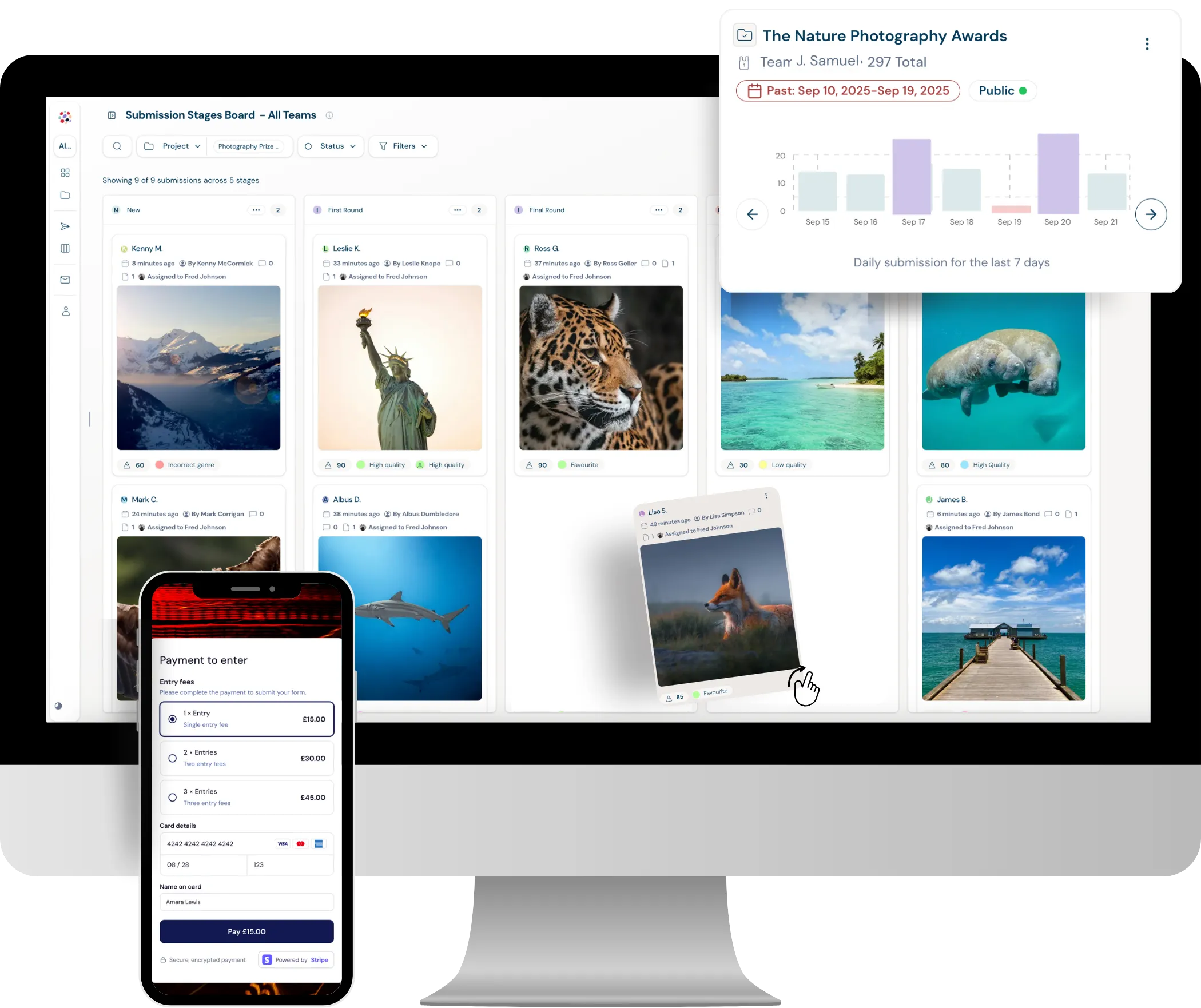
Best for: most awards, prizes, open calls and grant programmes, especially organisations running several a year that want one flexible, affordable platform they can set up themselves.
What stands out:
- A visual stages board. Entries move across columns, like a Kanban board, so the whole team can see where every entry sits. Judges can review entries in a full-screen slideshow, built for images, video and other visual work.
- Optional AI agents that will check eligibility, flag missing information or the wrong category, and tag and route entries to the right judges. People will still make every decision.
- AI connectors for Claude, ChatGPT and Cursor, so you can ask questions of your entry data and build reports and charts in plain English.
- Entry fees paid straight into your own Stripe account, with access codes, discounts and refunds.
- Galleries and public voting for shortlists and winners.
- Awards and grants on one platform, including fund management for budgets and payment schedules.
- Fair judging on every plan. Rubric scoring, custom criteria and anonymous judging (hiding entrant details from judges) are included as standard, not paid extras.
- Security: Cyber Essentials certified, UK and EU GDPR compliant, hosted on SOC 2-certified infrastructure.
Pricing: Starter costs £49 a month for 500 entries a year, Growth £179 a month for 2,500 entries, and Pro £349 a month for 10,000 entries, with two months free on annual billing. Those allowances are generous for the price: 500 entries a year on Zealous needs its Pro plan at £179 a month (£119 billed annually), and Evalato charges €4,500 for a single 200-entry programme. Starter suits smaller teams, with up to three judges and one review round per programme. No setup fees, a free trial with no time limit, and a 30-day money-back guarantee. Registered charities get 10% off annual Growth and Pro plans. Dapple charges 2% + 20p per entry fee payment; Pro includes a transaction fee cap. See Dapple’s pricing.
Where it falls short: programmes that need the entry form in several languages at once, or a native Salesforce integration. As a newer platform, it also has fewer third-party reviews than Award Force or Submittable.
2. Award Force: best for large, global, paid-entry programmes
Award Force is the most established dedicated awards platform, made by Creative Force and used by organisations such as the BBC, World Press Photo and Deloitte. It leads the awards category on G2 and is the default enterprise choice.
Best for: high-volume, multilingual or high-stakes programmes with a budget for annual software and onboarding.
What stands out:
- Four judging modes (scored, qualifying, top pick and voting), unlimited judging stages, leaderboards and conflict-of-interest controls.
- 40+ interface languages and entry fees in any currency on Pro.
- No commission on entry fees. You pay the subscription and your payment gateway, nothing else.
- Strong security credentials: ISO 27001, SOC 2, Cyber Essentials and a choice of data residency locations.
- Optional AI tools on all plans, plus 24/5 support and a free pre-launch check.
Pricing: Growth costs £2,300 ($3,250) a year but is for free-to-enter programmes only, with a 10MB file limit. Pro costs £4,600 ($6,500) a year and adds entry fees, full branding, multiple languages, unlimited file sizes and the API. Premier is quoted. Onboarding is an optional extra from £1,600.
Where it falls short: smaller budgets. If you charge entry fees, the real starting price is the £4,600 Pro plan, and the feature depth means a steeper learning curve for administrators. Salesforce and SSO are paid add-ons. See our Award Force alternative page.
3. Zealous: best for visual awards and a free starting tier
Zealous is a London-based awards and submissions platform with roots in the creative sector. Its judging experience is built around a visual gallery, which works well for art, photography and design entries. It also publishes satisfaction scores for hosts, judges and entrants, which few vendors do.
Best for: creative and visual awards, and organisers who want to start free and grow into a paid plan.
What stands out:
- A free plan for up to 20 entries a year, with no credit card.
- Unlimited programmes, judges and file storage on every paid plan.
- Visual, gallery-style judging with live slideshow mode for in-room judging.
- Multi-category submissions, volume deals (such as three for the price of two) and promo codes.
- Transparent, published pricing in seven currencies.
Pricing: Starter from £26 a month billed annually (75 entries), Pro from £79 a month billed annually (300 entries, scaling to 10,000), and Scale from £239 a month billed annually. Monthly billing costs about 50% more. Prices include VAT. Zealous charges 2.2% + 20p per entry fee transaction, capped at £2, on Starter, Pro and Scale.
Where it falls short: organisations that need full white-labelling, or that pay out and track grant money after the decision. Zealous says both itself. Starter is limited to a single scoring round, so most juried awards will need Pro. See our Zealous alternative page.
4. Submittable: best for grants, CSR and awards under one contract
Submittable is one of the oldest platforms in the space. It started with literary and creative submissions and has moved towards foundations, corporate social responsibility and grant-making. It now also owns WizeHive (Zengine).
Best for: foundations and corporates running grants, scholarships, employee giving and awards on one platform, with post-award tracking.
What stands out:
- Full grant lifecycle, from application through payment and reporting.
- Scale: Submittable reports powering over 145,000 social impact programmes.
- Anonymised review, annotation and in-app messaging for judges and panels.
- Fast launch for its size: Submittable says most customers launch a new programme in two weeks or less.
Pricing: quote only. Submittable does not publish prices, and third-party estimates for a full platform contract commonly start around $10,000 a year. On top of the subscription, Submittable charges 5% + $0.99 on every payment it collects. That makes paid-entry awards expensive: on a $40 entry fee, it takes $2.99 per entry, before payment processing.
Where it falls short: organisations that only want awards. You pay for a broad social impact toolkit, and creative organisations often find it more corporate and more expensive than they need. See our Submittable alternative page.
5. Evalato: best for single international programmes
Evalato is a European awards platform priced per programme rather than per year. It supports more than 40 languages and 160 currencies, and lets you test a full setup for free before you pay.
Best for: one annual programme with international entrants, or organisers who want to test thoroughly before launch.
What stands out:
- Unlimited free testing before a programme goes live.
- Many voting methods, including score, points, popularity, public, positional and single transferable vote, plus score normalisation on Pro.
- Embeddable registration forms that sit on your own website.
- Entry fees with time-based pricing (early-bird offers) and tax rules, paid into your own Stripe, Braintree or PayPal account.
- 24/7 email and chat support.
Pricing: each programme is paid once, at launch, and runs for 365 days. Grow costs €2,500 (50 entries), €3,500 (100) or €4,500 (200). Pro costs €5,500 for up to 10,000 entries. Prices exclude VAT, and Evalato does not offer a non-profit discount.
Where it falls short: organisations running several programmes a year, because each one is paid separately. The Grow tiers also cap entries tightly and limit uploads to 20MB per file.
6. OpenWater: best for associations with an existing tech stack
OpenWater is an application and review platform for awards, grants, scholarships and conference abstracts. It is built to plug into the membership and CRM systems that associations already run.
Best for: professional associations, academic institutions and large non-profits where awards data must sync with member records.
What stands out:
- CRM and association management system (AMS) integrations.
- Multi-round reviewer portals with scoring, comments and public galleries.
- Abstracts and awards on one platform, useful for conference organisers.
- A reputation for strong support on complex, institutional workflows.
Pricing: quote only. Third-party guides estimate starting budgets of roughly $6,000 to $7,000 a year, rising with integrations and programme count.
Where it falls short: teams without technical help. Getting the most from OpenWater usually needs someone comfortable with APIs, and setup can take several weeks. See our OpenWater alternative page.
7. SurveyMonkey Apply: best for scholarships and structured grant programmes
SurveyMonkey Apply is an application management platform for scholarships, grants, fellowships and awards. It is strongest where eligibility rules are strict and recipients need tracking after the decision.
Best for: universities, foundations and funders running rule-heavy application programmes with post-award tracking.
What stands out:
- Eligibility screening and automatic routing of applications.
- Simple and advanced review options for different panel types.
- Salesforce integration and single sign-on for enterprise teams.
- Free implementation for the first five programmes, according to third-party listings.
Pricing: quote only. Plans are tiered by applicant numbers: Pro covers up to 1,000 applicants on one programme and Enterprise up to 5,000 across ten programmes.
Where it falls short: simple recognition awards, public-facing competitions with voting, or anyone who wants to see a price before a sales call.
8. AwardStage: best for UK awards with a ceremony
AwardStage is a UK awards platform that pairs entry management with a custom awards website and an event ticketing module. It suits programmes where the awards night is as important as the entries.
Best for: trade and industry awards that sell gala tickets and want one supplier for both.
What stands out:
- A full custom awards website included on every plan.
- Event ticketing for ceremonies (a paid add-on on all tiers).
- Onboarding included in the price, with UK-based support.
- Public voting, multi-criteria scoring and sponsor logos on the entry-level plan.
Pricing: priced per awards programme, per year. Standard costs £2,350 for up to 249 entries and Pro £3,500 for 250 to 999 entries. Enterprise is quoted and is the only tier that covers several programmes and API access.
Where it falls short: organisers running several programmes a year, because each awards is priced separately below Enterprise. Standard also limits forms to 25 fields and five administrators.
9. Judgify: best for a free first programme
Judgify is a Singapore-based awards, contest and abstract management platform with a free tier. It is a practical way to run a first, small programme without a budget.
Best for: first-time or small awards, startup competitions and academic abstract calls.
What stands out:
- A free Basic plan for 100 entries per event, five categories and one private judging round.
- Public voting with social login on Pro.
- Abstract management alongside awards.
- Per-event pricing, so you only pay in the years you run a programme.
Pricing: Basic is free. Pro costs $699 per event and Pro Unlimited $2,399 a year, both plus an onboarding fee. Judgify charges a 3.5% fee on entry fees.
Where it falls short: growing programmes. Pro caps each event at 500 entries and 50MB files, custom domains and white-labelling are Enterprise only, and the 3.5% fee is the highest published commission in this guide.
10. Submit.com: best for public sector and regulated programmes
Submit.com is an Irish submission and grant management platform. It is especially popular with Irish government awards and funding schemes, and is also used by universities and foundations. Its focus is governance: audit trails, role-based permissions and multi-phase applications.
Best for: public bodies and regulated organisations that need a defensible, auditable process, particularly in Ireland.
What stands out:
- Smart forms with conditional logic and multi-phase applications.
- Automated scoring, tagging and routing of applications.
- External reviewer access with role-based permissions.
- Audit trails, dashboards and an API.
Pricing: Starter costs €5,995 a year for up to 1,000 applicants, 20 reviewers, five admins and one programme. Pro and Enterprise are quoted.
Where it falls short: creative or community awards. The compliance focus is more than most recognition programmes need, and €5,995 for a single programme is high for small organisers. See our Submit.com alternative page.
11. Reviewr: best for programmes that want templates and guidance
Reviewr is a US platform for scholarships, grants, awards and fellowships that leans on templates modelled on established programmes. It suits teams who would rather follow a proven process than design their own.
Best for: organisations launching their first major programme who want structure handed to them.
What stands out:
- Templates based on established award and scholarship programmes.
- Blind review, rubric scoring and score normalisation.
- Reference letter tracking and post-award management.
Pricing: third-party listings show Basic at $500 a year plus $1 to $10 per entry, and Standard at $1,200 a year plus per-entry rates. Reviewr’s own site asks you to book a call for pricing.
Where it falls short: high-volume programmes, where per-entry charges add up quickly, and teams that want to customise everything themselves. Reviewers note that some changes go through Reviewr’s support team rather than self-service.
Other platforms worth knowing
These platforms appear on other lists or serve a narrower niche. They are worth a look if your programme matches.
- Good Grants: Award Force’s sister product for grant-making, from the same company. Third-party listings show plans from €3,000 to €6,000 a year. Organisations that run both awards and grants often end up paying for Award Force and Good Grants side by side.
- Sessionboard Awards: an awards module inside a conference content platform. Best when award entrants are also your speakers or abstract submitters. Custom pricing.
- WizeHive (Zengine): a workflow-heavy grants and awards platform, now part of Submittable.
What does award management software really cost?
The true annual cost is the subscription plus any commission on entry fees, plus your payment processor’s fees. Comparing headline prices alone is misleading, because the platforms charge in four different ways.
The four pricing models
| Model | Who uses it | Works best when |
|---|---|---|
| Subscription + commission on entry fees | Dapple, Zealous, Judgify, Submittable | You run several programmes, or entry fees are modest |
| Flat annual fee, no commission | Award Force, AwardStage, Submit.com | Entry fees are high or volumes are large |
| Per programme | Evalato, AwardStage (per awards) | You run one programme a year |
| Base fee + per entry | Reviewr | Volumes are small and predictable |
Worked example: 600 paid entries at £40 each
One awards programme, 600 entries a year, a £40 entry fee, billed annually. Payment processor fees (such as Stripe’s) are excluded because they apply on every platform.
| Platform and plan | Software per year | Platform commission | Total per year |
|---|---|---|---|
| Dapple Growth | £1,790 | £600 (2% + 20p) | £2,390 |
| Zealous Pro (1,000 entries) | £2,088 | £648 (2.2% + 20p) | £2,736 (inc. VAT) |
| AwardStage Pro | £3,500 | Not stated | £3,500+ |
| Award Force Pro | £4,600 | £0 | £4,600 |
| Evalato Pro | €5,500 | Not stated | €5,500 (ex. VAT) |
Watch out for fees on high-value entries
Commission scales with your entry fee, so high-ticket programmes behave differently. A percentage that looks small on a low entry fee can add up quickly when entries cost more, and it can turn the cheapest-looking platform into the most expensive one.
If you charge higher entry fees, look for a cap on the platform’s transaction fee, or a commission-free model, so you don’t get stung by fees you didn’t budget for. Model your own entry volume and fee before comparing, and ask each vendor whether its commission is capped and on which plans.
How is AI changing award management software in 2026?
In 2026, AI in awards software mostly handles admin, not judging. The useful features check entries, summarise them and route them to the right people, while humans still pick the winners.
Age matters here. Most of the platforms in this guide have been around for a decade or more, and their core was designed before AI could do useful work inside the software. Adding AI to that kind of system is possible, but it is slower and usually ends up as a separate tool or a paid extra. Newer platforms can build their data, permissions and workflows around AI from the start, which is why it is worth asking every vendor not just what AI they offer today, but how it fits into the product over the next year.
Vendors are taking three different approaches:
- AI agents that do the admin. Dapple’s agents will check eligibility, flag missing information or the wrong category, and route entries to the right judges. Sessionboard offers similar “AI evaluators” for pre-screening.
- Optional, private AI tools. Award Force offers AI tools on every plan, designed so your data is not exposed to third parties.
- Connecting your data to AI assistants. Dapple connects to Claude, ChatGPT and Cursor, so you can ask questions of your entries and build reports in plain English. Sessionboard offers a similar connection for event data.
There is also a counter-trend. Zealous argues that because AI can now write a polished text entry, awards should ask for portfolios, video and other rich media that show real work. That is good advice whichever platform you choose.
Questions to ask any vendor about AI:
- Is every AI feature optional, and can I switch it off per programme?
- Is my entrants’ data used to train AI models?
- Does AI make or suggest any decisions, or only handle admin?
- Which plan includes it, and does it cost extra?
How to choose the right award management software
Start from your programme, not the feature list. Answer the four questions below, shortlist two or three platforms, then rebuild one real category in each before you sign.
1. How many programmes do you run a year? One a year points to per-programme pricing (Evalato) or a per-awards plan (AwardStage). Several a year points to a subscription that covers several programmes (Dapple, Zealous, Award Force).
2. Do you charge entry fees, and how much? Modest fees (under about £50) suit subscription-plus-commission models. High fees or very large volumes suit flat-fee platforms (Award Force) or plans with a fee cap (Dapple Pro, Zealous).
3. Does money go out after the decision? If you pay grants or bursaries and need reporting afterwards, shortlist platforms with fund or grant management: Dapple, Submittable, SurveyMonkey Apply, or Award Force paired with Good Grants.
4. Who will run it? A small team without technical support needs self-serve setup (Dapple, Zealous, Evalato, Judgify). A larger team with a project budget can use guided onboarding (Award Force, OpenWater, Submit.com).
Before you sign, test three things: submit a real entry on your phone, score five entries as a judge, and change a live form field. If any of those needs a support ticket, keep looking.
Frequently asked questions
How much does award management software cost?
Published prices run from free (Zealous for 20 entries, Judgify for 100 entries per event) to around €6,000 a year (Submit.com, Evalato Pro). Mid-market subscriptions sit between £2,000 and £5,000 a year. Submittable, OpenWater and SurveyMonkey Apply only quote on request. Commission on entry fees and payment processor fees usually come on top.
Is there free award management software?
Yes. Zealous has a free plan for up to 20 entries a year, and Judgify's Basic plan is free for up to 100 entries per event. Dapple offers a free trial with no time limit, but publishing a live form needs a paid plan. Free tiers cap entries, file sizes or judging rounds, so check them against your largest expected year.
Which award platforms don't take a cut of entry fees?
Award Force takes no commission on entry fees on any plan, but you need its Pro plan (£4,600 a year) to charge them. Evalato and AwardStage do not list a commission on their pricing pages. Dapple, Zealous, Judgify and Submittable charge a percentage plus a fixed fee per payment, with Submittable's 5% + $0.99 the highest, and Zealous and Dapple Pro cap it.
How long does it take to set up award management software?
Self-serve platforms such as Dapple, Zealous and Judgify can be live in hours. Evalato says new users typically need a day or two. Platforms with guided implementation, such as Award Force, OpenWater and Submit.com, usually take two to six weeks, depending on integrations.
What is the difference between award management and grant management software?
Award management ends at the decision: entries, judging and winners. Grant management continues after it, with payments, milestones and reporting. Dapple, Submittable and SurveyMonkey Apply cover both on one platform. Award Force and Good Grants are separate products from the same company.
Which award software supports multiple languages?
Award Force and Evalato both support more than 40 interface languages. Award Force lets entrants switch between several active languages on its Pro plan. Most smaller platforms, including Dapple, run each programme in a single language today.
What is the best award software for art and photography competitions?
Visual awards need large file uploads, gallery-style judging and public galleries. Dapple, Zealous and Award Force all support galleries and visual review, and all three offer slideshow-style judging for image and video entries. Check file size limits carefully: Award Force Growth caps uploads at 10MB per file and Evalato Grow at 20MB, which is too small for most video.
Sources
Vendor pages were checked in October 2026. Third-party figures are labelled as estimates in the text.
- Dapple pricing
- Award Force pricing and comparison page
- Zealous pricing and Zealous’s guide to awards management software
- Evalato pricing
- Judgify pricing
- AwardStage pricing
- Submittable awards management
- Guideflow: 10 best awards management software for 2026 (Submit.com, Reviewr, SurveyMonkey Apply and OpenWater pricing)
- Sessionboard: awards management software comparison guide
- G2 awards management category
- Good Grants on GetApp
Last updated October 2026. Competitor pricing verified against published pricing pages and third-party sources at time of writing; confirm current figures with each vendor.