The Best Grant Management Software in 2026: 13 Platforms Compared
We compared 13 platforms on price, how much of the grant lifecycle they cover, review tools, setup time and AI. Every one gets a “where it falls short” section, including ours.

Published on 11 November 2026
Reading time: 17 minutes
 Oz Osbaldeston, Co-founder & CEO at Dapple
Prices checked November 2026.
What is the best grant management software in 2026?
The best grant management software for most funders in 2026 is Submittable if you need the full lifecycle at scale, Good Grants if you want full-lifecycle tools at a published price, and Dapple if you want a modern, AI-first platform for the pre-award side at a fraction of legacy prices. Larger foundations with complex compliance needs should also shortlist Fluxx, SmartSimple and Foundant, and US government funders should look at Euna Grants (AmpliFund).
No single platform wins every category, so the right pick depends on two things: how much of the post-award process you need inside the software, and what you can spend.
If you need grant agreements, grantee progress reports and payment tracking in one place, choose a full-lifecycle platform such as Submittable, Good Grants or Foundant. If your bottleneck is the pre-award work (forms, eligibility checks, shortlisting and review), a lighter, modern platform such as Dapple will save more time for far less money, and it can be live in hours rather than months.
Quick picks
| If you need... | Our pick | Why |
|---|---|---|
| The full grant lifecycle, application to closeout | Submittable | Mature post-award tools and over 165,000 programmes supported |
| Full-lifecycle tools at a published price | Good Grants | From £2,800 / $3,950 a year with fund management and no distribution fees |
| ✦ Affordable, AI-first pre-award management | Dapple | The most modern platform here, live in hours, with configurable AI agents, visual stages and fund tracking from £179 / $239 a month |
| A private, family or community foundation | Foundant GLM | Built for foundations, with accounting links |
| A large foundation with complex workflows | Fluxx | Unlimited users and deep configuration |
| Research funding or highly regulated programmes | SmartSimple | Configurable compliance and finance integrations |
| A US state or local government grant programme | Euna Grants (AmpliFund) | Federal-grade compliance and subrecipient tracking |
| Corporate grantmaking alongside employee giving | Bonterra Grants Management | Grants, workplace giving and volunteering in one suite |
| One large public sector call | Submit.com | Strong intake and e-signature, popular with Irish and UK public bodies |
| Scholarships on a tight budget | SmarterSelect | Low published entry price |
A note on transparency, and how we compared
We make Dapple, so we are not neutral. Every vendor that writes one of these guides, Submittable, Submit.com and Reviewr included, ranks itself highly. We have tried to be fair, and we have not put ourselves first, because our post-award tools are still being built.
How we compared:
- Pricing: taken from each vendor’s own pricing page where one exists. Where a vendor only quotes on request, we use third-party listings (Capterra, G2, TrustRadius, TechImpact) and label them as estimates.
- Lifecycle coverage: pre-award (forms, eligibility, review), award (decisions, agreements, funds) and post-award (payments, grantee reports, closeout).
- Review tools: scoring, rubrics, blind review, reviewer assignment and conflicts of interest.
- Setup: how long a typical launch takes, and whether you need the vendor to make changes.
- AI: what is live today, what it does and which plans include it.
- Reviews: ratings on Capterra and G2, read alongside competitor guides from Submittable, Good Grants, Optimy, Reviewr, Submit.com and Plinth.
What is grant management software?
Grant management software is the system a funder uses to run a grant programme from the open call to the final report. It replaces the spreadsheets, shared inboxes and email chains most programmes start with. A good platform does five jobs:
- Collects applications through a branded portal with forms that save as applicants go.
- Checks eligibility so ineligible or incomplete applications never reach your reviewers.
- Runs review with scoring, rubrics, conflict-of-interest checks and blind review.
- Manages awards and funds: budgets, allocations, payment schedules and approvals.
- Tracks what happens next: grant agreements, grantee progress reports and closeout.
Steps one to three are usually called pre-award. Steps four and five are post-award. Some platforms are strongest at one end, so it is worth knowing which end your team spends most time on.
This guide is about software for grantmakers, the organisations giving money. If you are a nonprofit applying for grants, you want a grant-seeking tool such as Instrumentl instead.
What should you look for?
The must-haves
- A good applicant experience. Save-and-return forms, mobile-friendly pages and clear status updates. Applicants judge your programme by your portal.
- Eligibility screening. Rules or AI that catch ineligible applications before a person has to read them.
- Flexible review. Multiple review rounds, rubric scoring, blind review, and a way to split applications fairly across reviewers.
- Fund tracking. Budgets per programme, allocations per grantee and payment schedules you can report on.
- Reporting and exports. Board-ready reports without hours of spreadsheet work.
- Security. GDPR compliance, role-based permissions and an independent certification such as SOC 2 or Cyber Essentials.
The red flags
- No published pricing and a long sales cycle. Common at the enterprise end, and it makes budgeting hard.
- Separate implementation fees. Some platforms charge more to set up than a year of a smaller tool costs.
- Implementations measured in months. If you can’t open a round until next quarter, the software is setting your timetable.
- Key features locked in the top tier. Funds distribution, API access, SSO and automated review are often gated.
- Changes that need the vendor. If editing a form or workflow means raising a ticket, every new round will be slower.
- Per-user pricing. A 60-person review panel gets expensive fast.
Don’t overlook setup time, or a platform’s age
Grant management software has been around for decades. The problem has evolved, but the core job has stayed the same: collect applications, review them fairly and track the money. Many platforms on this list were built ten or twenty years ago, and they look and feel it, with dated interfaces, rigid workflows and changes that go through the vendor.
That age shows up in setup time. Fluxx implementations typically take three to six months, and government-grade platforms take months too. A modern, self-serve platform such as Dapple can be live in hours: build your form, set up your stages and open the round the same day. Ask every vendor how long a typical launch takes, and who does the work.
Don’t overlook AI
Every major platform now has some AI, but it varies widely. Some offer a writing assistant for building forms. Others can check eligibility, summarise long applications and route them to the right reviewers. Ask what is live today, what plan includes it, and whether your data is used to train models. We cover this in detail below.
Grant management software compared at a glance
| Platform | Best for | Starting price | Published pricing | Post-award depth | Free trial |
|---|---|---|---|---|---|
| Submittable | Full lifecycle at scale | Quote only (about $10,000 a year) | No | Strong (funds distribution on Enterprise) | No |
| Good Grants | Full lifecycle at a published price | £2,800 / $3,950 a year | Yes | Good (reports and agreements on Premium) | 14 days |
| ✦ Dapple | Affordable, AI-first pre-award | $2,390 a year for fund management | Yes | Good (fund management) | Yes |
| Foundant GLM | Private and community foundations | About $9,900 a year (Capterra) | No | Strong | No |
| Fluxx | Large, complex foundations | $13,000 a year plus setup | Partly | Strong | No |
| SmartSimple | Research and regulated funding | Quote only | No | Strong | No |
| Submit.com | One large public sector call | €5,995 a year | Partly | Good | Yes |
| SurveyMonkey Apply | Scholarships and structured programmes | Quote only | No | Light | No |
| Optimy | Corporate foundations and CSR | €8,000 a year | Partly | Good | No |
| Blackbaud Grantmaking | Existing Blackbaud customers | $325 per feature a month | Partly | Good | Yes |
| Euna Grants (AmpliFund) | US government grant programmes | About $15,000 a year (Software Advice) | No | Strong | No |
| Bonterra Grants Management | Corporate grantmaking and CSR | Quote only | No | Good | No |
| SmarterSelect | Scholarships on a budget | $2,000 a year (G2) | Partly | Light | Yes |
Prices are entry points and exclude tax. “Partly” means the vendor or a listing publishes a starting price, but most buyers get a quote.
1. Submittable: best for the full grant lifecycle at scale
Submittable is the best-known name in grant management and the platform most buyers compare everything else to. It covers the whole lifecycle, from the first application to closeout, and has the post-award depth that lighter tools are still building.
Best for: nonprofits, foundations, universities and corporate giving teams that want one mature platform for grants, scholarships and CSR.
What stands out:
- Scale and track record. Submittable says it has supported more than 165,000 programmes and over $10 billion in funds.
- Full lifecycle. Forms, eligibility screening, multi-round review, financial tracking, impact reporting and funds distribution.
- Easy for applicants. Reviewers consistently praise the portal, and Submittable rates 4.8 out of 5 from 398 reviews on Capterra.
- Broad CSR suite. Employee giving, matching and volunteering are available as add-ons, helped by its 2024 acquisition of WizeHive.
- AI tools. An AI assistant helps build and translate forms, and Automated Review can extract data from documents and apply custom scoring.
Pricing: quote only. Plans are Starter, Pro and Enterprise, with team seats and application limits set per customer. API access, SSO and automated review start on Pro, and funds distribution is Enterprise only. If you charge application fees, Submittable takes $0.99 plus 5% of each payment.
Where it falls short: price. GetApp reviewers mention steep jumps between tiers and extra fees, which hurts smaller teams running one round a year. Some of the most useful tools, including funds distribution and Automated Review, sit in the most expensive plans or are sold as custom extras. Competitor reviews also note that multi-year, tranche-based grants can feel limited compared with enterprise tools such as Fluxx.
2. Good Grants: best for full-lifecycle tools at a published price
Good Grants is the grants sister product of Award Force, and it is one of the few full-lifecycle platforms that publishes every price. It is a strong choice for small and mid-sized funders who want post-award tools without an enterprise contract.
Best for: small to mid-sized foundations, charities and scholarship programmes, especially those with international applicants.
What stands out:
- Transparent pricing. Every plan is on the website in five currencies, with unlimited users and no per-seat charges.
- No distribution fees. Good Grants takes no cut of the funds you allocate or pay out.
- Fund management on every plan. Budgets and fund allocations come as standard, with grant reporting and agreement signing on Premium.
- Multilingual. The interface is available in more than 40 languages.
- Privacy-first AI. Optional AI tools launched in January 2026, switched off by default and not trained on client data.
- Steady releases. Recent updates include grant report acceptance and a new dashboard.
Pricing: Intro is £2,800 / $3,950 a year and Premium is £5,600 / $7,900 a year, both up to 10,000 applications. Enterprise is quoted. Paying annually gives four months free compared with monthly billing, and there is a 14-day free trial.
Where it falls short: Intro is tight. It includes one application form, 10MB file uploads and no API or integrations, so most growing programmes end up on Premium. SAML SSO and Salesforce cost extra, and plagiarism checks need a separate Copyleaks subscription. Some reviews report the setup to be confusing and the pricing a poor fit for a single annual grant round.
3. Dapple: best for affordable, AI-first pre-award management
Dapple is a modern application and grant management platform built with AI at its core, not added later. It began in the creative sector, managing open calls, awards and residencies, and is now used for grants and fellowships by funders, universities and arts organisations. Its pre-award tools are among the most flexible in this list, and its post-award tools are growing fast.
It is also the newest platform here. Dapple was built in 2025, so it was designed around today’s AI tools and a clean, visual interface, rather than adding them to a system that is ten or twenty years old. Most teams can set up and open a round in hours, where some platforms on this list take months.
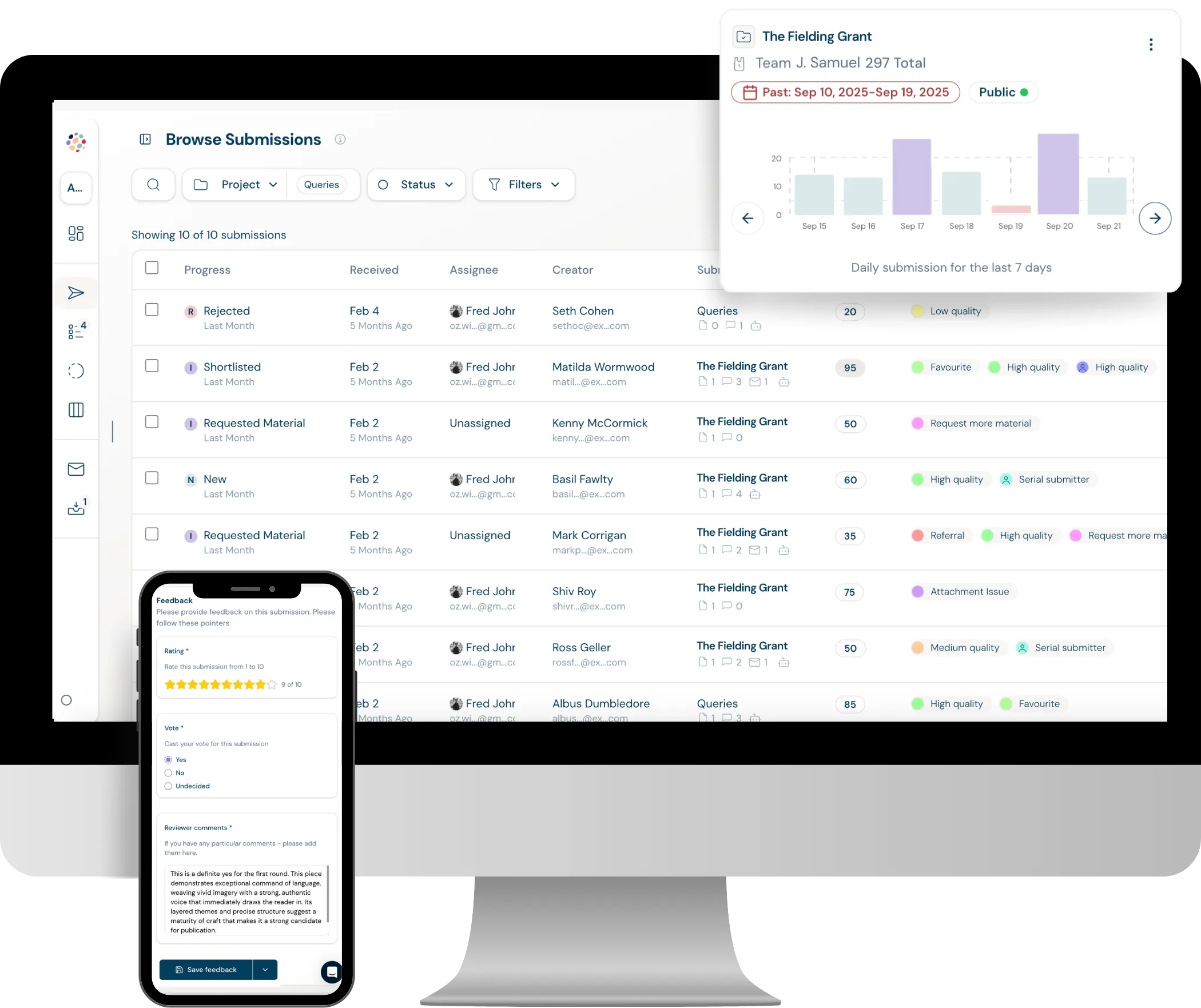
Best for: funders who want to cut the admin of running grant rounds, and who would rather not pay enterprise prices for features they won’t use.
What stands out:
- Live in hours, not months. An AI form builder, a template library and an intuitive flow mean your team can build and launch a round itself, the same day, without the need for onboarding or external setup help.
- The most modern platform on this list. Built in 2025, with a clean, visual interface that reviewers and applicants pick up without training.
- AI agents for the admin. You set up agents that check every application against your eligibility criteria, write a summary of each one, tag them, and route them to the right stage or review group. People still make every funding decision.
- Connects to Claude, ChatGPT and Cursor. Dapple’s AI connectors let your team ask questions of your data and build reports and charts in the AI tools they already use.
- Visual stages board. Every programme runs on a drag-and-drop board. Each stage can have its own automations and review rounds, so the workflow fits your process rather than the other way round.
- Fair, flexible review. Rubric or rating scoring, custom voting options, minimum and maximum reviews per application, review pools.
- Fund management. Set an overall budget and a fund per programme, allocate amounts to successful applicants, and track payment schedules and approvals against dates.
Pricing: fund management, AI agents, automations and the AI connectors are included from £179 / $239 a month, with two months free on annual billing. That plan covers up to 2,500 applications a year and up to 50 programmes. API access, webhooks and SSO come with the higher plan. Charities and nonprofits get a 10% discount. If you charge application fees, Dapple takes 2% + £0.20 per payment, plus Stripe’s processing fee. See Dapple’s pricing.
Where it falls short: post-award. Grant agreements and e-signatures, variance reports and accounting software integrations are on the roadmap but not live yet. Dapple tracks payments but does not send them, so you still pay grantees from your own bank or finance system. There is no native Salesforce integration.
4. Foundant GLM: best for private, family and community foundations
Foundant’s Grant Lifecycle Manager (GLM) has been around since 2006 and is a dependable choice for foundations that give year-round.
Best for: private, family and community foundations with small teams.
What stands out:
- Built for foundations. Applications, reviews, grant agreements, follow-ups and outcome tracking.
- Unlimited users. Staff, board members, reviewers and applicants are all included.
- Accounting links. QuickBooks Online integration syncs grant payments to your ledger, and a Candid integration checks charity status.
- Well-liked support. Reviewers often mention responsive support and a helpful user community.
Pricing: quote only. Capterra lists Standard at $9,900 a year and Advanced at $13,900 a year. TechImpact reported packages from $4,250 to $9,500 a year on a two-year contract, so check what your quote includes.
Where it falls short: the interface feels dated, and reviewers describe report building as confusing. Setting up several programmes can take longer than expected, and two-year contracts reduce flexibility.
5. Fluxx: best for large foundations with complex workflows
Fluxx is enterprise grant management software used by some of the largest foundations and government funders.
Best for: large, multi-programme foundations with in-house admin capacity.
What stands out:
- Deep configuration. Budgets, grantee engagement, analytics and closeout, shaped around complex processes.
- Unlimited users, forms and workflows. Cost does not grow with headcount.
- Analytics. Portfolio reporting through its Grantelligence product.
- Strong implementation team. Reviewers rate the onboarding support well.
Pricing: Fluxx says Grantmaker starts at $13,000 a year plus a one-time setup fee. TechImpact reported onboarding packages from $10,000 to more than $54,000.
Where it falls short: time and complexity. Implementations typically take three to six months, some form changes need the Liquid templating language, and the learning curve is steep. It is too much for a small team running a few rounds a year.
6. SmartSimple: best for government, research and regulated funding
SmartSimple Cloud is a highly configurable platform for funders with complex compliance, research or finance requirements.
Best for: government agencies, research funders and large foundations.
What stands out:
- Configurable without code. Admins can launch and change programmes themselves.
- Finance integrations. Prebuilt links to QuickBooks, Sage Intacct and Xero for budgets and payments.
- AI-assisted screening. Pre-screening of applications against criteria.
- Public sector ready. Listed on the UK government’s G-Cloud framework.
Pricing: quote only, with implementation fees on top of the subscription.
Where it falls short: setup effort and price. It suits organisations with dedicated system admins, and smaller funders will pay for more platform than they need.
7. Submit.com: best for one large public sector call
Submit.com is an Irish platform that is especially popular with Irish and UK public bodies for grants, scholarships and awards.
Best for: public sector and regulated programmes running one big, crowded round.
What stands out:
- Strong intake and review. Smart forms, multi-phase submissions and panel scoring.
- Contracts built in. Contract generation and e-signatures.
- Highly rated. 4.8 out of 5 on G2 and Capterra.
- Procurement-friendly. Listed on G-Cloud.
Pricing: Starter is €5,995 a year for one programme, 1,000 applicants, 5 admins and 20 reviewers. Pro and Enterprise are quoted.
Where it falls short: Starter covers a single programme, so funders running several rounds will need a bigger plan. Payment schedules sit above Starter, and the platform mainly supports English.
8. SurveyMonkey Apply: best for scholarships and structured programmes
SurveyMonkey Apply (SM Apply) brings the familiar SurveyMonkey brand to application management.
Best for: universities and associations running scholarships or structured programmes.
What stands out:
- Stable vendor. Backed by a large, established company.
- Familiar forms. Easy for teams who already use SurveyMonkey.
- Unlimited reviews. Included on its entry plan.
- Well reviewed. 4.5 out of 5 from about 320 reviews on Capterra.
Pricing: quote only. Listings show an entry plan for up to 1,000 applicants and one programme.
Where it falls short: competitor reviews say review features feel added on, and post-award and compliance tracking are light. Complex review processes often need workarounds.
9. Optimy: best for corporate foundations and CSR
Optimy is a Belgian platform for grants, sponsorships and volunteering, with strong impact reporting.
Best for: corporate foundations and CSR teams running several programme types.
What stands out:
- One platform for social impact. Grants, sponsorships and volunteering together.
- ESG reporting. Built-in CSRD, SFDR and SDG alignment.
- Dedicated support. A named specialist from day one.
- Security. ISO 27001 certified.
Pricing: Optimy says it starts at €8,000 a year.
Where it falls short: pricing is per module, there is no free trial, and implementations take longer than lighter tools.
10. Blackbaud Grantmaking: best for existing Blackbaud customers
Blackbaud Grantmaking connects grant management to Blackbaud’s fundraising and finance tools.
Best for: foundations already running on Blackbaud.
What stands out:
- Ecosystem. Links to Blackbaud’s finance and CRM products.
- Enterprise features. Grant tracking, document management and reporting.
- Training. Extensive learning resources.
Pricing: listings show $325 per feature a month, with full pricing on quote.
Where it falls short: ease of use. It scores 3.4 out of 5 for ease of use on Capterra, and reviewers describe simple tasks taking too many steps and pricing that varies between clients.
11. Euna Grants (AmpliFund): best for US government grant programmes
AmpliFund is a grant management platform built for public sector funders that hand out and track government money. Euna Solutions bought it in March 2025, and it now sits within Euna Grants. It serves more than 220 customers across North America, including several state-wide rollouts.
Best for: US state and local government agencies, and large organisations passing federal funds to subrecipients.
What stands out:
- Compliance depth. Built for the audit trails, financial oversight and reporting that federal funding demands.
- Subrecipient tracking. Detailed reporting from the organisations you fund, plus custom forms for each programme.
- Full lifecycle. Application, award, payment tracking, performance reporting and closeout.
- Wider public sector suite. Euna also sells budgeting, procurement and payments software, and bought AI grant research startup GrantExec in January 2026.
Pricing: quote only. Software Advice lists a starting price of $15,000 a year, across Core, Advanced and Enterprise tiers.
Where it falls short: it is built for government compliance, so it is heavy for a foundation, charity or arts funder running a few rounds a year. Pricing isn’t published, implementations take months, and its focus is firmly North American.
12. Bonterra Grants Management: best for corporate grantmaking alongside employee giving
Bonterra Grants Management, formerly CyberGrants, is part of Bonterra’s wider nonprofit and CSR software suite. It is aimed at companies and corporate foundations that run grants next to workplace giving and volunteering.
Best for: corporate foundations and large CSR teams that want grants, employee giving and volunteering under one contract.
What stands out:
- Flexible workflow engine. Configurable rules, routing and approvals for many programmes running on different timetables.
- Detailed reporting. Reviewers describe the reporting as very comprehensive.
- CSR in one place. Grants sit alongside employee giving, matching and volunteering.
- Budget and in-kind tracking. Programme budgets, invitation codes and in-kind giving management.
Pricing: quote only. Grants Management, Employee Engagement and an Enterprise bundle are each priced on request.
Where it falls short: reviewers report an inconsistent experience across the products Bonterra has acquired, many clicks to find information, and long implementations. Routine changes often need vendor help, and its core grants product doesn’t include AI-assisted application review. It has only 15 reviews on G2, with an average of 4.1 out of 5.
13. SmarterSelect: best for scholarships on a budget
SmarterSelect is a simple, affordable platform aimed at scholarship and small grant programmes.
Best for: small nonprofits and schools running scholarships.
What stands out:
- Low entry price. One of the cheapest options in this list.
- Quick templates. Fast to launch a simple programme.
- Fund distribution. Payments through its SendGrant integration.
- Responsive chat support.
Pricing: G2 lists Create at $2,000 a year (500 users), Enhance at $5,000 and Enterprise at $9,000. SmarterSelect asks you to contact it for current prices.
Where it falls short: review, compliance and reporting tools are lighter than the rest of this list, some features are reserved for higher tiers, and there is no phone support.
Other platforms worth knowing
- Award Force: Good Grants’ sister product, built for awards rather than grants. See our guide to award management software.
- Instrumentl: a grant-seeking tool for nonprofits looking for funding, not a platform for running a grant programme.
What about CSR and employee giving platforms?
You will see Benevity, YourCause, Deed, Groundswell and Uncommon Giving in many grant software comparisons, including Submittable’s. They are mainly workplace giving platforms. Companies use them to match employee donations, run volunteering and make some corporate grants. They are not built for running open calls or competitive grant rounds, so we haven’t reviewed them here.
- Benevity: large-scale corporate giving, matching and volunteering for big employers.
- YourCause: employee giving and volunteering, now part of Blackbaud.
- Deed: a CSR platform for giving, volunteering and community investment.
- Groundswell: employee giving, volunteering and corporate grantmaking from one account.
- Uncommon Giving: simple workplace giving with donor-advised accounts for employees.
If your company runs both an employee giving programme and competitive grants, a CSR suite such as Submittable, Bonterra or Benevity may suit you. If you only run grants, a dedicated grant management platform will be simpler and cheaper.
What does grant management software really cost?
Grant management software costs anywhere from about £2,000 to more than £20,000 a year, and the headline price is rarely the whole bill. Most enterprise vendors only quote on request, and setup fees, add-ons and per-user charges can double the first-year cost.
| Pricing model | How it works | Examples |
|---|---|---|
| Published subscription | A fixed monthly or annual price on the website | Dapple, Good Grants, SmarterSelect |
| Quote only | Price depends on volume, users and features | Submittable, SmartSimple, SurveyMonkey Apply, Foundant GLM |
| Subscription plus implementation | An annual licence plus a one-off setup fee | Fluxx, SmartSimple |
| Per feature or module | You pay for each part of the platform you switch on | Blackbaud Grantmaking, Optimy |
| Fees on applicant payments | A percentage of any application fee you collect | Submittable, Dapple |
A worked example
Take a foundation running two grant rounds a year, with about 800 applications, 15 reviewers and a need to track grant payments. It does not charge application fees.
| Platform | Likely plan | Estimated first-year cost |
|---|---|---|
| ✦ Dapple | Plan with fund management, billed annually | £1,790 / $2,390 |
| Good Grants | Premium (Intro allows one form) | £5,600 / $7,900 |
| Submit.com | Starter if both rounds count as one programme | From €5,995 |
| Foundant GLM | Standard | About $9,900 (Capterra) |
| Fluxx | Grantmaker plus onboarding | $23,000 or more |
| Submittable | Starter or Pro | $10,000 |
These are our estimates from published and third-party prices, before tax and any discounts. Get written quotes before you decide.
Watch out for fees on application payments
Most grant programmes do not charge applicants, but fellowships, residencies and some open calls do. On a $50 application fee, Submittable takes $0.99 plus 5%, or roughly $3.49 sent in monthly instalments, which includes card processing. Dapple takes 2% + $0.25, or roughly $1.25 paid instantly, and Stripe’s card fee is charged separately.
How is AI changing grant management software in 2026?
AI is moving from writing help to doing real admin work. Every platform in this list now mentions AI, but what it actually does differs a lot.
- Submittable offers an AI assistant that builds and translates forms, and Automated Review, a custom premium feature that extracts data from documents and applies scoring rules. Submittable says customers save an average of 3.4 admin hours a week with it.
- Good Grants launched optional, privacy-first AI tools in January 2026. They are off by default and are not trained on shared client data.
- SmartSimple offers AI-assisted pre-screening of applications.
- Dapple lets you set up AI agents that check eligibility against your own criteria, summarise each application, tag it, and route it to the right stage or review group. Its AI connectors let you analyse programme data in Claude, ChatGPT or Cursor.
The common thread is that AI should take on the admin, so reviewers spend their time on judgement. No serious platform suggests letting AI make funding decisions, and with AI-written applications on the rise, that human review matters more than ever.
Questions to ask every vendor:
- Which AI features are live today, and which are on the roadmap?
- Which plan includes them, and do they cost extra?
- Is our data used to train any models?
- Can we switch AI off for a programme?
- Can a person see and override every AI decision?
How to choose the right grant management software
Start with these four questions:
- Where does your team lose the most time? If it is screening and reviewing applications, prioritise pre-award tools and AI. If it is chasing grantee reports and payments, prioritise post-award depth.
- How many rounds do you run, and how many applications? Check form, programme and application limits against next year’s plans, not this year’s.
- Who needs access? Count staff, board members and external reviewers. Per-user pricing gets expensive with large panels.
- What do you need to connect to? Accounting software, a CRM such as Salesforce, or single sign-on can rule platforms in or out.
Before you sign
- Ask for the full first-year cost, including setup, training and add-ons.
- Check which features are in your plan, not just the product.
- Ask how long a typical launch takes, and who does the work.
- Run a real application through a trial or sandbox with your own reviewers.
- Confirm how you can export your data if you leave.
Frequently asked questions
What is the best grant management software?
For the full lifecycle at scale, Submittable. For full-lifecycle tools at a published price, Good Grants. For affordable, AI-first pre-award management, Dapple. Large foundations with complex compliance needs should look at Fluxx, SmartSimple or Foundant GLM, and US government grant offices at Euna Grants (AmpliFund).
What is the best grant management software for small foundations and nonprofits?
Look for published pricing, no setup fees and unlimited users. Dapple, Good Grants and SmarterSelect all publish their prices and can be set up without a long implementation.
How long does it take to set up grant management software?
It ranges from hours to months. Dapple is self-serve, so most teams can build a form, set up their stages and open a round in hours. Enterprise platforms take far longer: Fluxx implementations typically take three to six months, and Euna Grants (AmpliFund) implementations also take months.
How much does grant management software cost?
Entry plans start at about £2,000 to £3,000 a year for lighter tools. Mid-market platforms typically cost roughly £5,000 to £15,000 a year. Enterprise platforms such as Fluxx can pass £20,000 in the first year once setup fees are added.
What is the difference between pre-award and post-award grant management?
Pre-award covers everything before a funding decision: the application form, eligibility checks and review. Post-award covers what happens after: grant agreements, payments, grantee progress reports and closeout.
Can grant management software pay grantees?
Some can. Submittable includes funds distribution on its Enterprise plan, and SmarterSelect pays through SendGrant. Most platforms, including Good Grants and Dapple, track budgets and payment schedules while you pay grantees through your own bank or finance system.
Is Submittable worth the price?
For large programmes that need mature post-award tools and CSR features, often yes. For smaller teams running one or two rounds a year, reviewers often find the price hard to justify, and a lighter platform may cover what they need.
Good Grants or Submittable?
Good Grants publishes its prices, charges no distribution fees and suits small to mid-sized funders. Submittable is quote-only and costs more, but offers more scale, a CSR suite and funds distribution.
Sources
Vendor pages were checked in November 2026. Third-party figures are labelled as estimates in the text.
- Submittable pricing and grant management overview
- Submittable fees and payments and Automated Review
- Submittable’s cost of grant management software guide
- Submittable on Capterra and GetApp
- Submittable’s competitor comparisons
- GeekWire: Submittable acquires WizeHive
- Good Grants pricing and AI tools announcement
- Good Grants pricing review on G2
- Dapple pricing
- Foundant GLM on Capterra and TechImpact
- Fluxx pricing FAQ and TechImpact on Fluxx
- SmartSimple on ERP Research
- Submit.com on Software Finder
- SurveyMonkey Apply on Software Advice
- Optimy pricing and Optimy vs Good Grants
- Blackbaud Grantmaking on Capterra
- Euna Solutions acquires AmpliFund and Euna Grants on Software Advice
- Euna acquires GrantExec
- Bonterra CyberGrants on G2 and Plinth’s Bonterra review
- SmarterSelect on G2
- Reviewr: best grant management software
- Optimy: best grant management software
- Plinth: best Submittable alternatives
- Hack’celeration: grant management software for funders
Last updated November 2026.
Explore More
The Best Award Management Software in 2026
11 award platforms compared on pricing, entry fee commission, judging and setup.
How to Choose Submission Management Software
A buyer's guide to choosing the right platform for your programmes.
Grant and Fund Management
Budgets, awards and payment tracking after your funding decisions.