How to Write Rejection Emails Applicants Don’t Resent (With 8 Templates)
What the best rejection emails do differently, plus eight templates for open calls, grants, awards, residencies and more.

Published on October 6, 2026
Reading time: 12 mins
 Oz Osbaldeston, Co-founder, Dapple
Introduction
The short answer: a rejection email applicants don’t resent is personal, prompt and honest. Use their first name, thank them for their time, give the decision early, show how competitive it was with real numbers, be honest about feedback and invite them back. The best ones add a small gift.
Here’s the uncomfortable maths. Run an open call with 400 applications and 20 places, and 95% of the people who ever deal with your programme will receive exactly one email from you: the no.
Our own data says the same thing. Of all the messages organisations sent to applicants through Dapple so far in 2026, 78% were rejection emails. For every acceptance, waitlist update or reminder, there were roughly three or four rejections.
Think about it another way. That email isn’t admin but probably one of the most-read things your organisation will write all year.
Most of us treat it like admin anyway. We dust off last year’s “Dear Applicant”, swap the dates, and send it from a no-reply address on a Friday evening. Then we wonder why next year’s numbers are down and the group chat has opinions.
It doesn’t have to be that way. We’ve seen a lot of rejection emails. Some bad. Most OK. Some that are exceptional. Some so good that applicants screenshot, share and reply to with thank-you notes. This guide breaks down what those emails do differently, then gives you eight templates you can adapt today: for open calls, grants, awards, residencies, near misses, ineligible applications and more.
Why do rejection emails matter so much?
Rejection emails matter because the people you turn down are most of your community. They’re next year’s applicants, this year’s audience, and the people who tell their peers whether your programme is worth the effort. A cold or careless no costs you all three.
Start from the applicant’s side. A good application takes hours, often days: writing and rewriting the statement, photographing the work, building the budget, wrestling the upload button at 11pm before the deadline. Many have paid an entry fee too. The least they’re owed is a reply that acknowledges that time.
The research backs this up. Talent Board’s candidate experience research, covering more than 195,000 job seekers, found that resentment drops by 29% when rejected candidates receive feedback (HCM Technology Report). Funders see the same pattern. In St. David’s Foundation’s 2025 survey of 203 declined grant applicants, run with the Center for Effective Philanthropy, the lowest-rated area was how honestly the foundation explained its decisions (35th percentile), and only 47% of applicants who asked for feedback received it (St. David’s Foundation).
Put simply: people can handle a no. What they resent is being made to feel their effort went into a void.
What should a good rejection email include?
A good rejection email includes nine things: the applicant’s first name, a genuine thank-you for their time, a clear decision early on, the numbers behind it, reassurance that it isn’t a verdict on their worth, an honest line on feedback, an invitation to apply again, a small gift where you can, and a real human sign-off.
| Ingredient | Why it matters | Example line |
|---|---|---|
| First name | “Dear Applicant” tells them they were a row in a spreadsheet. | “Hi [First name],” |
| Thanks for the effort | Acknowledges the hours, not just the “interest”. | “We know an application is never five minutes.” |
| A clear decision, early | Burying the no in paragraph four feels like a trick. | “I’m sorry to tell you your work hasn’t been selected this time.” |
| The numbers | Real figures prove it was competitive, not personal. | “[412] people applied for [14] places.” |
| Not a verdict on them | Separates the decision from their worth as a maker or organisation. | “This is about one theme, one space and one panel.” |
| Honesty about feedback | Silence implies you’re hiding something; honesty doesn’t. | “We can’t give individual feedback, and we’d rather say so.” |
| An invitation back | Turns an ending into a next step. | “We’ll email you first when [Call name] reopens.” |
| A token of thanks | Something in return for their time changes how the no lands. | “Reply with your address and we’ll post you a sketchbook.” |
| A human sign-off | A name to reply to beats a no-reply inbox. | “With warmth, [Your name] & the team” |
What does a really good rejection email look like?
A brilliant rejection email sounds like a person who has been rejected themselves. One of the best we’ve seen came from No Place Art, an independent artist-led open call, for its Edition Two exhibition on the theme of Materiality. Applicants didn’t just accept it. They replied in their dozens to say thank you, and asked how to stay involved.
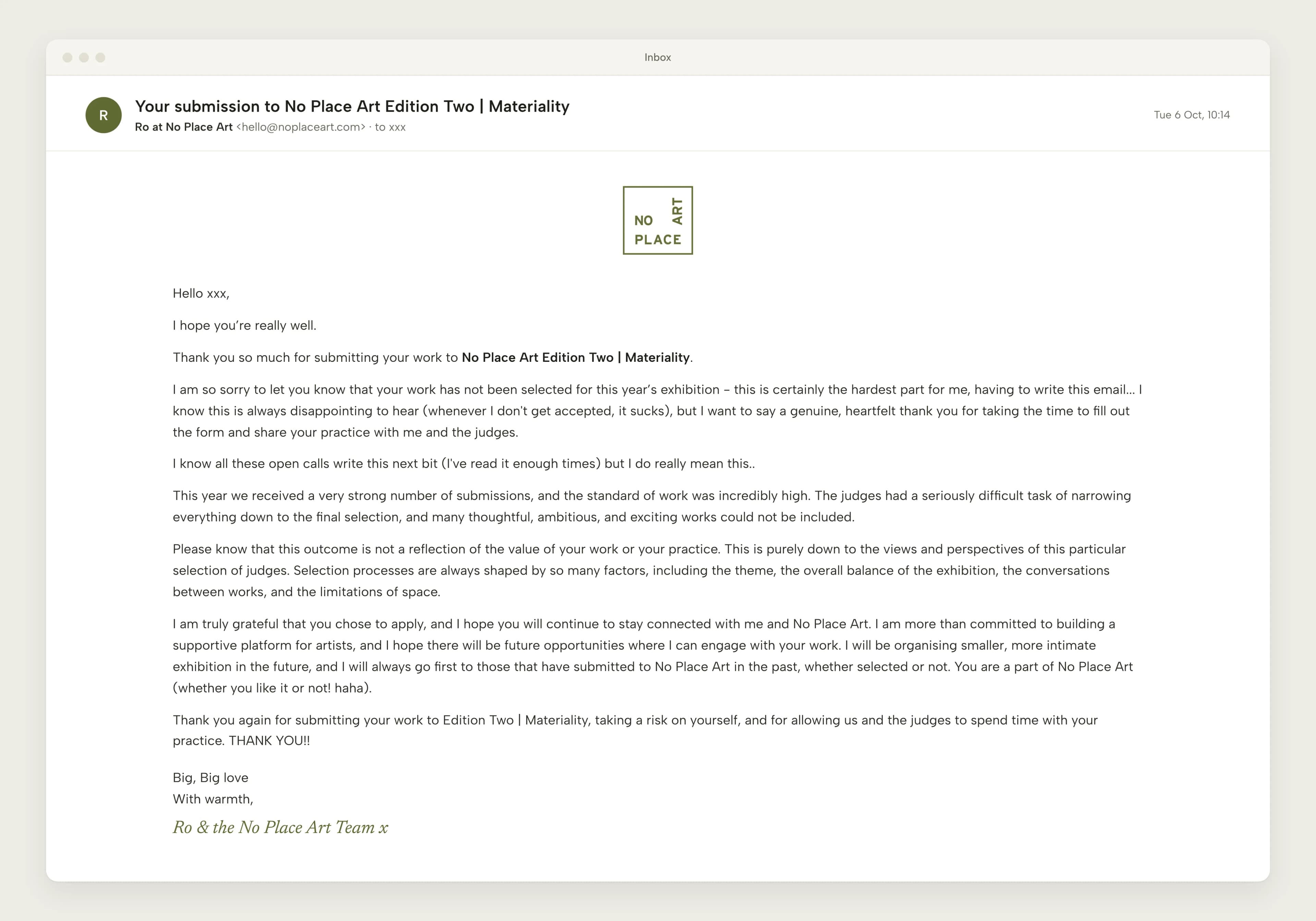
Here’s what it does that most rejection emails don’t:
- It admits the email is hard to write. “This is certainly the hardest part for me, having to write this email.” The sender is on the applicant’s side of the table.
- It speaks as a peer. “Whenever I don’t get accepted, it sucks.” One line, and the power gap closes.
- It names the cliché before using it. “I know all these open calls write this next bit (I’ve read it enough times) but I do really mean this.” Self-awareness makes the “strong year” line believable.
- It explains how selection really works. “views and perspectives of this particular selection of judges. Selection processes are always shaped by so many factors, including the theme, the overall balance of the exhibition, the conversations between works, and the limitations of space.”
- It offers something concrete. Future, smaller exhibitions where past applicants get first look, “whether selected or not.”
- It makes them part of something. “You are a part of No Place Art (whether you like it or not!).” That line is why people forwarded it.
- It thanks them for the risk. “Thank you for… taking a risk on yourself.” It honours the act of applying, not just the application.
How should you start a rejection email?
Start with their first name and a genuine thank-you, then give the decision in the first two or three lines. Don’t open cold with the no, and don’t make them scroll to find it. Most people will read the email on their phone, braced for the answer; give it to them kindly and quickly.
The subject line matters too, because it’s the first thing they see. It should be honest without delivering the verdict before they’ve opened it.
| Avoid | Use instead | Why |
|---|---|---|
| “Unfortunately…” | “[Call name]: thank you, [First name]” | The verdict in the subject line feels like a slap in the inbox. |
| “Application update” | “Your application to [Fund name]” | Vague subjects feel like spam or false hope. |
| “Congratulations on applying!” | “[Call name]: our decision” | A falsely upbeat subject line makes the no sting harder. |
How do you mention the numbers without it sounding like a brag?
Use the numbers to reassure, not to impress. “412 people applied for 14 places” tells the applicant the odds were long; “our most successful call ever!” tells them you’re celebrating while they’re not. State the figures plainly, then connect them to the care that went into the decision.
Three numbers do most of the work: how many applied, how many were selected, and how much time the judges spent. A ratio (“about 30 applications for every spot”) is easier to feel than a percentage. If you can, add a human detail: every application read by at least two judges, a shortlist argued over for a full day. Specifics are what make “it was incredibly competitive” believable rather than boilerplate.
Should you give feedback to unsuccessful applicants?
Offer feedback if you can, and say plainly if you can’t. For most programmes, individual feedback for every applicant simply isn’t feasible: a team of two can’t write 400 thoughtful notes. That’s fine. What damages trust is silence, or a vague “we’re unable to enter into correspondence” that sounds like a closed door.
Feedback doesn’t have to be all or nothing. Pick the rung that matches your capacity:
| Option | Works best for | Effort |
|---|---|---|
| Individual written feedback for everyone | Small programmes (under ~50 applications) and grants with significant asks | High |
| Feedback for the shortlist only | Calls where the near misses were genuinely close | Medium |
| Feedback on request, within a set window | Funders; most applicants won’t ask, those who do value it most | Medium |
| A “what the judges noticed” round-up | High-volume open calls, prizes and awards | Low |
| A live or recorded Q&A with the panel | Annual programmes that want repeat applicants | Low to medium |
One warning: reviewer comments written for internal scoring are not feedback. “Weak budget, 2/5” needs rewriting before an applicant sees it. AI tools are useful for turning a pile of reviewer notes into a draft summary, but a person should read every word before it goes out.
Can a rejection email be funny?
Yes, a rejection email can be funny, as long as the joke is on you, the process or the impossible maths, and never on their work or the decision. One or two light lines are enough. Humour signals that a human wrote this, which is exactly what a templated no lacks.
Lines that work:
- “Our judges argued (politely, mostly) over far more work than we could ever hang.”
- “Every rejection email says the standard was incredibly high. Ours does too. The difference is that ours is true.”
- “We can’t send individual feedback. With 412 applications, our team of three would finish around next year’s deadline.”
- “Once you’ve applied, you’re one of us. There’s no unsubscribe from that. (There is from our newsletter. Legally, we have to.)”
Lines that don’t: anything sarcastic about the quality of submissions, jokes about applicants who missed the brief, or exclamation marks right after the bad news. Funny should feel warm, not flippant. If you’re unsure whether a line lands, read it as the person who spent last weekend on their application.
How do you make a rejection email inspiring?
A rejection email inspires when it treats the no as a chapter, not a conclusion. Remind applicants that rejection is part of every creative and funded life, point them at something concrete to do next, and leave the door visibly open. Specific beats sentimental every time.
“Every artist you admire has a folder of emails like this one” is encouraging. “Everything happens for a reason” is not. Likewise, “plenty of the artists in this year’s show have had this exact email from us before” is far more motivating than “don’t give up!”, but only use it if it’s true. The aim is that they close the email wanting to apply again, not wanting to give up.
What can you offer applicants besides a rejection?
Liberty London went one step further and attached a gift. Unsuccessful applicants to its beauty calendar open call were offered a custom Liberty sketchbook, “a place for all your future projects to take shape”, and simply had to reply with a postal address. Hundreds of artists did. You can offer unsuccessful applicants any small token that gives something back for their time: free tickets, a discount on next year’s fee, a book, or access to a workshop. It doesn’t need to be expensive. It needs to say “we valued what you gave us”, and it turns a rejection into the start of a relationship.
| Offer | Good for | Cost |
|---|---|---|
| A branded sketchbook or notebook (the Liberty move) | Visual arts, design and writing calls | ££, plus postage |
| Free tickets to the exhibition, opening or awards night | Exhibitions, prizes, festivals | Low, if you have capacity |
| A discount or fee waiver on next year’s entry | Fee-charging open calls and awards | Low, and it drives reapplications |
| A complimentary book, catalogue or anthology | Literary prizes, publishers, foundations | ££ |
| A free workshop, masterclass or “how to apply” session | Grants, fellowships, residencies | Low (one session serves everyone) |
| First access to smaller future opportunities | Galleries and curators | Free |
| A draw for a handful of portfolio reviews | Any programme with generous judges | Judges’ time |
| Membership of an applicant community or newsletter | Programmes building long-term networks | Free |
If you ask for postal addresses by reply, only use them to send the gift, and say so. It’s a small detail, but applicants notice.
Rejection email templates for every situation
These eight templates cover the situations programme teams face most. Each is written to be adapted, not pasted: swap in your real numbers, your real offer and your own voice. Anything in [brackets] is a placeholder. Keep a template only if every claim in it is true for your programme.
- Open call or exhibition rejection (the one people forward)
- Grant or funding rejection
- The near miss: shortlisted but not selected
- Award or prize: not longlisted
- Residency or fellowship rejection
- High-volume rejection with no feedback
- Ineligible application
- Repeat applicant
1. Open call or exhibition rejection (the one people forward)
Use it for: arts open calls, juried exhibitions and contests, especially where applicants paid an entry fee or made a big creative effort.
Subject line
[Call name]: thank you, [First name] (and a small gift)
Hi [First name],
Thank you for applying to [Call name]. We know an application is never “five minutes”. It’s evenings, second drafts, a wrestle with the upload button and at least one moment of wondering whether to bother. You bothered, and we’re grateful.
I’m really sorry to tell you that your work hasn’t been selected for this year’s exhibition.
[412] artists applied for [14] places. That’s roughly [30] applications for every spot on the wall. Our judges spent [three weeks] with the submissions and argued (politely, mostly) over far more work than we could ever hang.
Please don’t read this as a verdict on your practice. It’s the outcome of one theme, one space and one panel of judges in one particular year. Plenty of the artists in this year’s show have had this exact email from us before.
We can’t send individual feedback. With [412] applications, our team of [three] would finish sometime around next year’s deadline. Instead, we’ve written up what the judges talked about most, and you can read it here: [link].
As a thank-you for your time, we’d love to [send you a [Organisation] sketchbook / give you two free tickets to our opening night on [date]]. Just reply with [your postal address / “count me in”] by [date].
[Call name] opens again in [month]. We’ll tell you first, and we really hope you’ll apply.
One more thing: once you’ve applied, you’re one of us. There’s no unsubscribe from that. (There is from our newsletter. Legally, we have to.)
With warmth, [Your name] & the [Organisation] team
2. Grant or funding rejection
Use it for: foundations, trusts, councils and funders declining a grant, bursary or commission application.
Subject line
Your application to [Fund name]
Dear [First name],
Thank you for applying to [Fund name]. A strong grant application takes days of work: the budget, the outcomes, the impact section you rewrote four times. We want to recognise the time and thought you put into yours.
I’m sorry to let you know that we’re unable to fund your application in this round.
We received [186] applications asking for a combined [£2.4 million]. We had [£300,000] to award, which meant funding [14] projects, around [8%] of those who applied. Many of the projects we couldn’t fund were ones our panel would have been proud to support.
[If you offer feedback:] Our panel left notes on every application. If you’d like a summary of their comments, reply by [date] and we’ll send it within [two weeks].
[If you don’t:] We’re not able to offer individual feedback this round, and we’d rather tell you that plainly than promise something we can’t deliver. Our [funding priorities guide / recorded briefing] explains what the panel weighed most: [link].
Our next round opens on [date]. If your project still fits our priorities, we’d encourage you to apply again. We’re also running a free [online session on applying] on [date], open to everyone who applied this time: [link].
Thank you for the work you do, and for thinking of us.
Warm regards, [Your name] [Job title], [Organisation]
3. The near miss: shortlisted but not selected
Use it for: applicants who reached a shortlist, longlist or final review round. These people deserve more than the standard email.
Subject line
[Call name]: you made our shortlist, [First name]
Hi [First name],
Thank you for applying to [Call name]. I wanted to write to you personally, because your application made our shortlist of [25] from [412]. That puts you in the top [6%] of everyone who applied. I hope that means something to you, because it means a lot to us.
I’m sorry to say that in the final round, your work wasn’t selected.
Honestly, the gap between the shortlist and the final selection this year was tiny. A different panel on a different day could easily have made a different call. Because you came so close, here’s what our judges said:
– What stood out: [specific strength, in plain language] – What tipped the final decision: [specific, kind and actionable point]
We’d love you to be at [the opening / the awards evening] on [date] as our guest. Reply and I’ll put your name on the list.
Please apply again when [Call name] reopens in [month]. I’ll be looking out for your name.
With warmth, [Your name] [Job title], [Organisation]
4. Award or prize: not longlisted
Use it for: literary prizes, design and photography awards, and any competition with a public ceremony.
Subject line
[Prize name] [year]: thank you for entering, [First name]
Hi [First name],
Thank you for entering [Prize name]. Putting your work in front of judges takes nerve, and we don’t take it lightly.
I’m sorry to let you know that [your entry / your book] hasn’t been longlisted this year.
We received [1,240] entries from [38] countries, and every one was read by at least [two] judges before the longlist was chosen. It was the hardest year to judge in the prize’s history, and I don’t say that lightly, because we’ve all read that sentence in rejection emails before.
We’d love you to be part of the night anyway. Here’s a free [ticket / livestream link] for the winners’ announcement on [date]: [link]. Come and cheer. Or come and quietly judge the judges. We won’t tell.
Entries for [year + 1] open in [month]. Every writer you admire has a folder of emails like this one; we hope this one ends up as a footnote to your story.
With best wishes, [Your name] & the [Prize name] team
5. Residency or fellowship rejection
Use it for: artist residencies, fellowships, accelerators and development programmes.
Subject line
Your application for the [Residency name]
Hi [First name],
Thank you for applying for the [Residency name]. Applying for a residency means imagining a whole season of your life somewhere else: the project, the logistics, possibly a conversation with your landlord. We know that’s a lot to put into a form.
I’m sorry to tell you that we’re not able to offer you a place this year.
We had [298] applications for [6] places. Our selection had to balance practices, disciplines and what each resident would need from the space, which meant saying no to many people we’d have loved to host.
A residency is only a few weeks; the community is year-round. We run [monthly online crits / open studio days / a newsletter of opportunities] that are open to everyone who applied, not just the residents. You’re on the list now: [link].
Applications for [year + 1] open in [month]. We’d love to see where your practice has got to by then.
With warmth, [Your name] & the [Organisation] team
6. High-volume rejection with no feedback
Use it for: very large calls where you can’t offer feedback or a gift, and need something short, honest and still human.
Subject line
[Call name]: our decision
Hi [First name],
Thank you for applying to [Call name], and for trusting us with your work.
I’m sorry to tell you that your [submission / application] hasn’t been selected this time.
We received [2,150] applications, the most we’ve ever had, for [40] places. Every submission was reviewed by [at least two members of our panel].
We’re a small team, so we can’t offer individual feedback. We’d rather be honest about that than leave you waiting for notes that won’t arrive.
[Call name] returns in [month], and we’d love to hear from you again.
Thank you, [Your name], [Organisation]
7. Ineligible application
Use it for: applications that couldn’t be reviewed because they didn’t meet the eligibility criteria.
Subject line
Your application to [Call name]: eligibility
Hi [First name],
Thank you for applying to [Call name].
I’m sorry to let you know that we can’t take your application forward, because it doesn’t meet one of our eligibility criteria: [specific criterion, e.g. applicants must be based in the UK / work must have been made in the last two years].
That means your work wasn’t assessed by our judges, so this isn’t a judgement on its quality in any way.
[If you charged a fee:] We’ve refunded your [£15] entry fee in full. It should reach you within [5–10 working days].
[Optional:] Based on what you sent, [Other opportunity] might be a better fit: [link].
We hope to see you again for a future call.
Best wishes, [Your name], [Organisation]
8. Repeat applicant
Use it for: people who’ve applied before and are hearing no again. A second no stings differently, so acknowledge it.
Subject line
[Call name]: thank you for coming back, [First name]
Hi [First name],
Thank you for applying to [Call name] again. Coming back after a no takes real nerve, and we noticed.
I’m sorry it isn’t a yes this year either. I know a second no lands differently from the first.
[412] artists applied for [14] places this year. [Several] of the artists we’re showing applied more than once before they were selected, so persistence really does count here.
Because you’ve applied more than once, we’d like to offer you [a short summary of the panel’s comments / a 15-minute call with our curator]. Just reply to this email by [date].
And as a small thank-you for sticking with us: [your entry fee for next year’s call is on us / a sketchbook is on its way if you reply with your address].
With warmth, [Your name] & the [Organisation] team
What should you never say in a rejection email?
Never use language that makes the applicant feel processed rather than heard. The worst offenders are stock phrases that every applicant has read a hundred times, and practical slip-ups that turn a disappointment into a grievance.
| Instead of | Try | Why |
|---|---|---|
| “Dear Applicant” | “Hi [First name]” | The fastest way to say “you’re a number”. |
| “We regret to inform you…” | “I’m sorry to tell you…” | Nobody talks like that. Write like a person. |
| “Due to the high volume of applications…” | “[412] people applied for [14] places.” | Numbers are believable; “high volume” is filler. |
| “We wish you every success in your future endeavours.” | “We’d love to see your next application.” | One closes the door; the other holds it open. |
| “The decision is final and we cannot enter into correspondence.” | “We can’t change decisions, but we’re always happy to hear from you.” | Same boundary, without the slammed door. |
| Sending from noreply@ | Sending from a named person | A reply-to-nobody address tells them nobody’s listening. |
Two practical mistakes to avoid as well: never put every applicant’s address in the To or CC field (that’s a data breach, not just an embarrassment), and never let applicants find out from your Instagram announcement before their email arrives.
When should you send rejection emails?
Send rejection emails after your selected applicants have confirmed their places, before any public announcement, and on the date you promised in your call. Confirming acceptances first means you can still offer places to your reserve list. Sending before the announcement means nobody learns the news from social media.
Send everyone in the same batch, so no one’s left refreshing their inbox while friends compare notes in the group chat. A weekday morning in the applicant’s time zone is kinder than a Friday evening; nobody needs a rejection to sit with all weekend. And if your timeline slips, tell applicants before the promised date passes, not after.
How do you personalise rejection emails at scale?
You personalise rejection emails at scale by segmenting, not by writing hundreds of individual emails. Sort unsuccessful applicants into three or four groups (not selected, shortlisted, ineligible, repeat applicants), write one excellent template for each, and merge in their first name and the call name. Four thoughtful templates feel more personal than one generic email sent to everyone.
Then make the mechanics easy on yourself:
- Write your templates before the call opens. Outcome week is the worst possible time to be drafting from scratch.
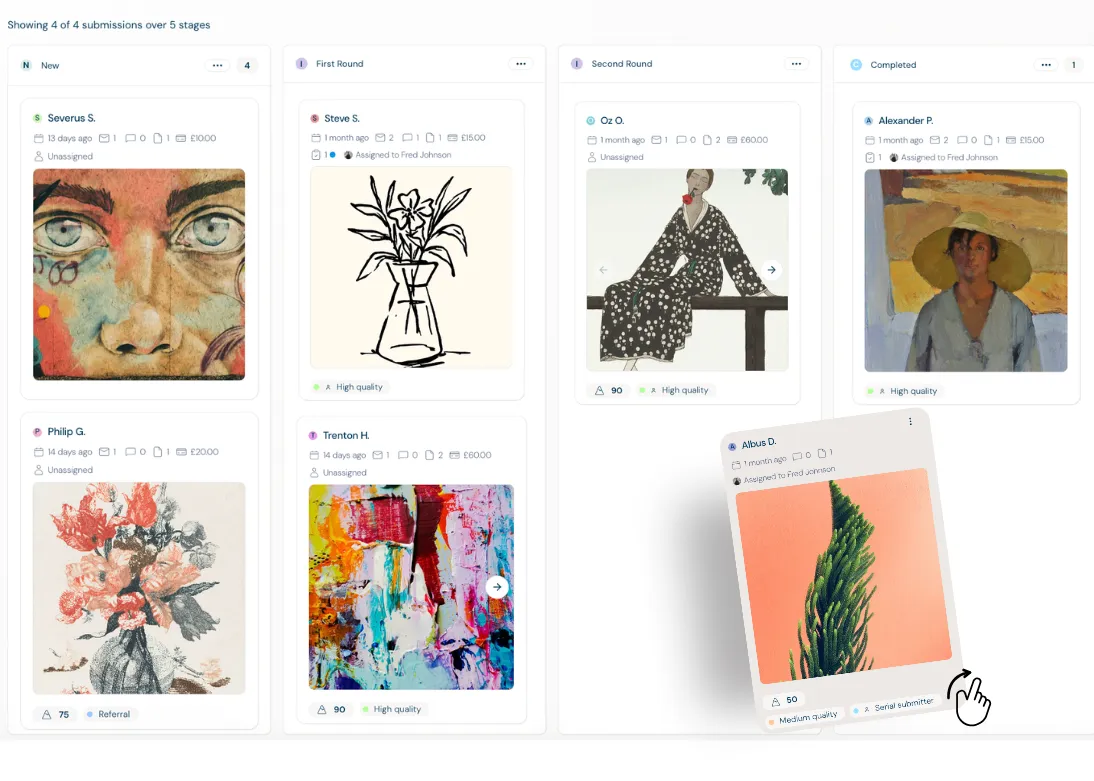
- Move submissions into stages that match your segments, so each group is ready to message in one go.
- Send from a named person, and keep replies switched on if you’re offering a gift or feedback on request.
- Send all of each segment at once, and check one test email on your phone first.
This is the kind of admin that software should take off your plate, so your time goes on the human part: the words. In Dapple, you move unsuccessful submissions into a stage such as “Not selected”, tick them, and choose With Selected → Message to send a saved template to the whole group, with replies on or off as you choose. The same applies to your shortlist and ineligible groups. Growth and Pro plans can also connect Dapple to AI assistants such as Claude or ChatGPT, which helps when you’re turning a pile of reviewer comments into draft feedback for your near misses.
Frequently asked questions about rejection emails
How long should a rejection email be?
A rejection email should usually be 150 to 300 words. That’s long enough to thank the applicant properly, explain the numbers and invite them back, and short enough to read on a phone. Near-miss emails with feedback can run longer.
Is it okay to reject applicants by email?
Yes. Email is the standard and expected way to share outcomes for grants, awards, residencies and open calls. A phone call is a lovely touch for a small shortlist, but the real mistake is sending nothing at all.
Should you tell applicants how many people applied?
Yes. Sharing how many people applied and how many places were available is the most credible way to show the decision was competitive rather than personal. Use real figures, not phrases like “a high volume of applications”.
Do you have to give feedback to unsuccessful applicants?
Most open calls, awards and private funders aren’t required to give feedback, though some public funding schemes set their own rules, so check yours. If you can’t offer individual feedback, say so honestly and offer a general summary of what the judges looked for instead.
What is a good subject line for a rejection email?
A good rejection email subject line names the call and the person without giving away the decision, such as “[Call name]: thank you, [First name]”. Avoid “Unfortunately” in the subject line and avoid vague subjects like “Update”.
Should a rejection email come from a person or the organisation?
A rejection email should come from a named person, ideally the programme lead, with a reply address that someone actually reads. Applicants are far more forgiving of a decision when they can see a human made it.
What should you do if an applicant replies upset?
Reply once, kindly and within a few days. Thank them for telling you, acknowledge the disappointment, and restate any offer you made, such as feedback or next year’s dates, without reopening the decision.
How can a rejection email strengthen your organisation’s reputation?
A rejection email strengthens your reputation when it leaves applicants feeling valued rather than processed, because the people you turn down this year are your applicants next year, your audience at the opening, and the voices deciding whether a friend should bother applying. When No Place Art told applicants they were part of the family “whether you like it or not”, people replied asking how to get more involved. When Liberty offered a sketchbook, hundreds took them up on it. Neither cost much. Both turned a no into a reason to stay.
So write it like it matters, because to the person reading it, it does. Thank them for their time. Tell them the truth. Give them something back if you can. And ask them to come back.
If you’re sending outcome emails from a spreadsheet and a mail merge, see how Dapple handles applicant messaging: saved templates, bulk messages by stage and one place for every reply, so you spend outcome week on the words, not the admin.
Explore More
How to Set Up Your Judging Process So Judges Actually Enjoy It
Build a review process your panel looks forward to.
Why Creative Organisations Are Moving Away From Email
Why inboxes and mail merges stop working as programmes grow.
How to Run an Open Call for Artists
A practical open-call playbook from launch to shortlist.