How to Choose Software for Residency and Open-Call Applications
Yes, there are specialised platforms for managing residency applications. The ones residencies use most are Submittable, SlideRoom, CaFÉ, Acceptd, Zealous and Dapple, alongside general form tools such as Google Forms and Jotform. Which one fits depends on six things residency teams deal with every cycle: portfolio and video uploads, references, fee waivers and bursaries, multi-round review with an outside panel, shortlisting and interviews, and showing selected artists' work publicly.

Published on 20 November 2026
Reading time: 10 minutes
 Oz Osbaldeston, Co-founder & CEO, Dapple
This guide is for teams running artist, writer, performing arts and research residencies, fellowships and open calls. It covers what to look for, how the main platforms compare, and where Dapple fits, including what it doesn't do yet.
A note on bias: Dapple publishes this guide, and we've included our own platform. We've tried to describe every platform fairly, using their public information, and to be clear about where Dapple has limits. Details were checked in November 2026; features and pricing change, so check with each vendor before you decide.
What is residency application software?
Residency application software is submission management software built to take a residency or fellowship from open call to selected cohort. It collects applications and work samples, takes any application fee, gives reviewers and selection committees a place to score and discuss applicants, and tracks who has been offered a place and who has accepted.
Residencies ask more of software than most awards or contests. There are fewer places, and applications go deeper: a proposal, a CV, a portfolio or video, sometimes references, often a statement about why now. Selection usually involves people from outside the organisation. And the work doesn't stop at a decision, because a cohort has to be confirmed, welcomed and often shown publicly.
What should residency application software handle?
| Requirement | Why it matters for residencies | What to ask a vendor |
|---|---|---|
| Portfolio, file and video uploads | Work samples are the core of the application | Can applicants upload video files and paste links, and can reviewers watch both inside the application? |
| References | Many fellowships ask for a referee or letter | Do referees submit directly, or does the applicant upload the letter? |
| Fee waivers and bursaries | Fees fund admin but can exclude artists | Can the form skip payment automatically for eligible applicants? Can it issue tax invoices? |
| Multi-round review with an outside panel | Committees often include external artists and curators | Can external reviewers score without access to your dashboard or applicant names? |
| Shortlisting and interviews | Most residencies shortlist before a final round | Can you move a shortlist to a new stage with its own review criteria? |
| Public galleries | Selected residents' work builds the programme's profile | Can you publish selected work without exporting it to another tool? |
Portfolio, file and video uploads
A residency application is only as good as the reviewer's view of the work. Visual artists send images and PDFs. Performing artists, filmmakers and composers send video and audio. Some applicants upload files; others prefer to share a YouTube or Vimeo link to work that is already online.
A good platform accepts both and lets reviewers watch, look and read inside the application, rather than downloading files or opening ten browser tabs. For performing arts residencies such as those at Baryshnikov Arts Center in New York, where applicants work across dance, music, theatre and multimedia, video playback is the review.
References
Fellowships and longer residencies often ask for one or two references. There are two common approaches: the platform emails referees a private link so they submit directly, or the applicant uploads a letter or gives a referee's contact details. Direct submission keeps letters confidential; uploads are simpler for everyone. Decide which you need before you compare platforms.
Fee waivers, bursaries and fair application fees
Application fees help cover the cost of selection, but a flat fee can shut out the artists a residency most wants to reach. Many residencies now combine a fee with exemptions: waivers for applicants from lower-income countries, bursary codes, or reduced fees for early-career artists.
The Jan van Eyck Academie in Maastricht is a good example. It charges a €65 application fee, plus VAT where it applies, and waives the fee entirely for applicants from and living in countries on the OECD DAC list of ODA recipients. Running that well takes software that can do two things:
- Skip payment automatically when an applicant's country is on the waiver list, so eligible artists never see a checkout.
- Handle tax correctly, including reverse-charge VAT invoices for business or freelance applicants in other EU countries, so the residency isn't reconciling invoices by hand.
For more on setting fees fairly, see our guides to setting entry fees and taking entry fees with Stripe.
Multi-round review with an outside panel
Most residency selection runs in rounds: an internal eligibility check, a first read, then a committee. Depending on their size, applications are often assessed by a selection committee made up of the director, the curator or programme lead and resident liaison, and external professionals.
Outside panellists need a simple way in. Look for:
- Reviewer accounts that show only the applications and fields assigned to them.
- Separate criteria and scoring for each round, so a first read and a final committee can work differently.
- Anonymous review, with the option to reveal names when the committee needs them.
- A way for reviewers to declare a conflict of interest.
Our guide to building a scoring rubric and running a fair judging panel covers the review design in more detail.
Shortlisting and interviews
After the first round, most residencies shortlist a small group for a closer look, a studio visit or an interview. The software should let you move that shortlist into its own stage, with its own reviewers and notes, and message everyone in it at once. Very few submission platforms schedule interviews themselves; most teams pair them with a booking tool.
Public galleries for selected artists
Announcing a cohort is also a chance to show the work. A public gallery of selected residents, published from the same platform that handled selection, saves rebuilding profiles on your website and keeps images and bios consistent.
Multiple programmes, teams and users
Many residency organisations run more than one call: a main residency, a fellowship with a partner, a site-specific programme. Check whether each programme costs extra, and whether different teams (and their reviewers) can work separately in one account.
Which platforms do residencies use for applications?
These are the platforms residency teams most often use, listed alphabetically. Each has a different starting point, so the right choice depends on your programme.
| Platform | Built mainly for | Typical residency fit |
|---|---|---|
| Acceptd | Performing arts applications and auditions | Performing arts programmes with auditions |
| CaFÉ | US calls for entry and public art | US visual arts calls |
| Dapple | Grants, awards, fellowships, residencies and open calls | Residencies wanting fees, review and galleries in one place |
| General form tools | Any kind of form | Small, free residencies with few applications |
| SlideRoom | Portfolio-based admissions | US universities and academic residencies |
| Submittable | Grants, publishing and many programme types | Organisations running many kinds of programme |
| Zealous | Awards and art calls | Entry-based art prizes and calls |
Acceptd is an application and audition platform for the performing and visual arts, widely used by music, dance and theatre schools. It is strong on video prescreens and audition scheduling, including live virtual auditions. It suits performing arts residencies that audition applicants. Check how well it fits a residency's committee review and cohort management, since its roots are in admissions.
CaFÉ (CallForEntry.org), run by Creative West, is a long-standing call-for-entry system used across the US for exhibitions, public art and some residencies, with a public listing of open calls. It suits US visual arts calls on a budget. Check how much flexibility you need in forms and multi-round review.
General form tools such as Google Forms, Jotform, Tally and Airtable are where many residencies start. They cost little and work for a small, free call. Once you add fees, video, outside reviewers and scoring, the process usually spreads across spreadsheets, shared drives and email.
SlideRoom, by Liaison, is a portfolio and application system used by many universities and some art schools. It supports rich media, reference requests and fee waivers. It suits institutions already in Liaison's admissions ecosystem. Check whether an admissions-shaped tool matches how your residency selects and manages a cohort.
Submittable is a broad application platform used by many US residencies, as well as grant-makers and publishers. It supports reference letter requests and workflow automation. It suits organisations that want one established vendor across many programme types. Submittable can be expensive, so check with them which features sit on which plan, and how the cost works for a single residency.
Zealous is a UK platform built mainly for awards and art calls, with public voting. It suits entry-based art prizes and open calls. Check how it handles residency needs such as references, deeper applications and post-selection cohort work.
Dapple is covered in the next section.
Where does Dapple fit for residencies?
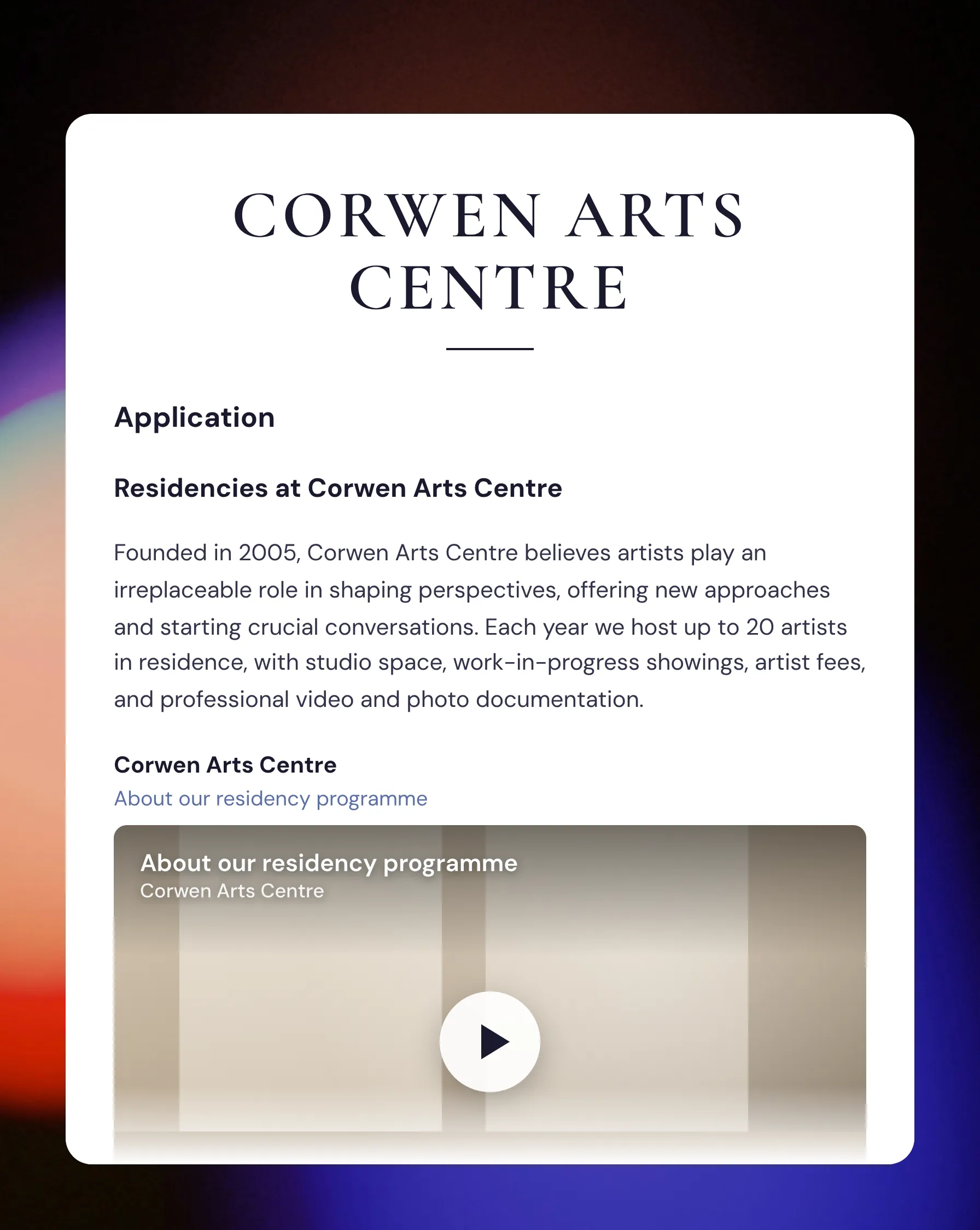
Dapple is an intelligent submission management platform for grants, awards, fellowships, residencies and open calls. It started in the creative sector, and residencies remain one of its core uses. Internationally recognised institutions on multiple continents use it, including the Jan van Eyck Academie in Maastricht, a multidisciplinary post-academic institute that welcomes artists, designers, writers and researchers from around the world; the Baryshnikov Arts Center in New York, which runs residencies across dance, music, theatre and multimedia; Evermay in Washington DC, whose Future Fellows Program is a residential fellowship for scientists, artists, technologists and other thinkers; and the Seoul Institute of the Arts in South Korea. Many more residencies and arts organisations across the US, Europe and Asia use Dapple for their calls too.
What Dapple does well for residencies
- Fees that stay fair. Fees are paid through the residency's own Stripe account, with cards, Apple Pay and Google Pay. Conditional logic can skip payment entirely for eligible applicants, which is how the Jan van Eyck Academie waives its fee for applicants from DAC-list countries. A tax ID field at checkout triggers a proper invoice, including reverse-charge VAT for business applicants. Applicants get receipts in their own account.
- Video, however applicants send it. Applicants can upload video files or share links, and reviewers can watch both from inside the application.
- Review Rounds built for committees. Each stage can have its own Review Round, with its own criteria, scoring, guidance and Review Group. External reviewers get their own login without access to your dashboard. Fields can be hidden, names revealed only when needed, and reviewers can declare a conflict of interest with a reason. Feedback from reviewers can also be sent to applicants in bulk, so they hear directly how the panel saw their application.
- A visual view of the whole call. The Stages board shows every application as a card with a thumbnail of the work or a headshot, so you can preview images or documents in one click and drag applications between stages, from first read to shortlist to offer.
- Galleries in minutes. Any stage can be published as a public gallery, with optional public voting, so a selected cohort can go online the day it is announced.
- Room for a whole team. Multiple organisations, teams and projects live in one account, each with its own rules, forms and reviewers. Several residencies or fellowships can run side by side, and teams can bulk-message applicants from templates.
- A modern interface. Larger institutions often tell us the interface is what persuaded their team, because staff and outside reviewers need little or no training.
- Smart tools for the admin, if you want them. Optional intelligence can check eligibility, summarise applications and tag or route them. It is off unless you turn it on, and people make every selection decision.

Where Dapple has limits
- References: At present Dapple can't send referees a direct link (a feature in Submittable). Instead, the applicant uploads the reference, or the residency sends referees a separate form link.
- Interviews: Dapple doesn't schedule interviews. Most teams move the shortlist to an interview stage and pair it with a booking tool.
- Languages: forms run in one language. Forms, however, are fully customisable and a programme can have several, meaning teams often duplicate a form and translate it for different speakers.
- Labels and price lists: Dapple exports data, but doesn't produce artwork labels or price lists for exhibitions.
How do you choose residency application software?
- Map your process first. Write down each stage, from open call to confirmed cohort, who reviews at each one, and what they need to see.
- Apply as an artist. Submit a test application with a real portfolio, a video file and a video link. If it's awkward for you, it will be awkward for applicants.
- Invite an outside reviewer to test. Ask a past panellist to score three test applications and tell you what got in the way.
- Run your fee rules through checkout. Test a waiver, a bursary code and, if you charge VAT, an applicant with a tax ID.
- Price every programme, not just one. Add up the cost of all your calls over a year, including transaction fees.
- Ask about switching. If you're moving mid-year, ask how forms, past applicants and reviewers come across.
Frequently asked questions
Are there specialised platforms for residency application management?
Yes. Submittable, SlideRoom, CaFÉ, Acceptd, Zealous and Dapple are all used for residency applications. They differ in what they were built for: admissions, auditions, awards or a mix of programmes. Small residencies also use general form tools.
Can applicants submit video with a residency application?
On most specialised platforms, yes. Check whether applicants can both upload files and share links, and whether reviewers can watch inside the application. Dapple supports both.
How do residencies handle application fee waivers?
The fairest approach is usually a fee with built-in exemptions, such as automatic waivers for applicants from countries on the OECD DAC list, or bursary codes. The software should skip payment automatically for eligible applicants rather than refunding them later.
Can external panellists review applications anonymously?
Yes, on most specialised platforms. In Dapple, admins choose which fields reviewers see, can reveal names when needed, and reviewers can declare a conflict of interest.
Is Google Forms enough for a small residency?
For a small, free call with one reviewer, often yes. Once you add fees, video, outside reviewers or more than a few dozen applications, a dedicated platform usually saves more time than it costs.
Can one platform run several residencies or fellowships?
Yes. Dapple lets you run several projects in one account, each with its own forms, stages and reviewers. Check whether other platforms charge per programme.
Where to go next
Explore More
Application Software for Artist Residencies
How residencies run applications, fees, review and galleries in Dapple.
How to Run an Open Call for Artists
Planning, launching, promoting and reviewing an open call.
Customer Story: Evermay
How Evermay runs its Future Fellows Program residential fellowship.